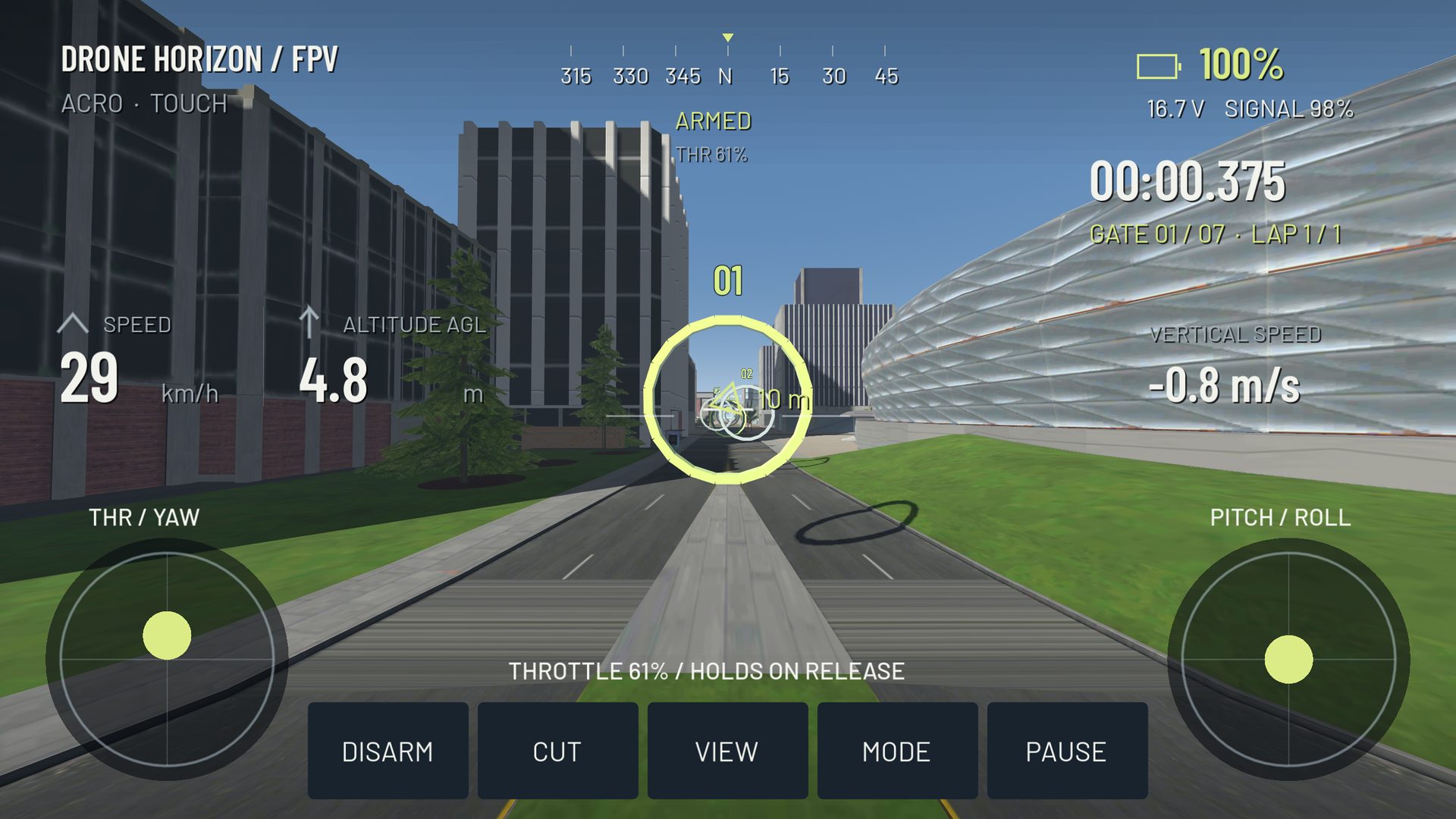
Every pilot command can be described with four axes. The names sound technical, but each one answers a simple question: How much lift? Which way is the nose pointing? Which way is the aircraft tilted? Learn them separately, then combine them in slow flight.
| Axis | What the aircraft does | Mode 2 stick |
|---|---|---|
| Throttle | Changes commanded motor output and therefore lift | Left, up/down |
| Yaw | Rotates around the vertical axis; changes heading | Left, left/right |
| Pitch | Tilts the nose forward or backward | Right, up/down |
| Roll | Tilts left or right | Right, left/right |
These are pilot input axes, not four independent movement directions. Pitching forward tilts the thrust vector and usually creates forward acceleration; it can also reduce the vertical part of lift. A turn therefore asks for more coordination than moving a stick sideways.
Throttle: control lift
Throttle controls motor output. In a manual-throttle quadcopter, raising the stick generally increases total thrust, but the aircraft does not automatically stop climbing at a chosen height. Hover is a balance between thrust and weight, and it changes with the aircraft, battery and flight attitude.
Assisted camera drones may interpret the stick differently, using onboard control to hold altitude or position when released. Do not transfer that expectation into a manual FPV mode. In Drone Horizon's manual modes, throttle remains the pilot's responsibility; there is no hidden altitude hold. Practice small changes over open ground before combining throttle with fast turns.
Yaw: point the nose
Yaw rotates the aircraft around its vertical axis. From an outside view, you see the nose swing. In FPV, the whole scene pans. Yaw is useful for aiming the camera through the exit of a turn, but yaw alone may create a sliding, inefficient corner. Add roll to bank the aircraft and manage pitch and throttle to keep the desired line.
A good exercise is to hover, turn 90 degrees, pause, and repeat. Keep the drone roughly over the same spot. If it drifts, note whether the cause was a pitch/roll input or the correction you made after the yaw.
Pitch: move the nose up and down
Pitch tilts the aircraft forward or backward. In a common Mode 2 layout, pushing the right stick forward commands nose-down pitch. The forward-tilted thrust vector accelerates the aircraft in that direction. Pulling back can slow forward motion, but a late correction can make the drone climb or overshoot in a different way.
Watch the horizon in FPV. A change in its position is an attitude cue, not a speedometer. The aircraft can still carry momentum after you release or reverse pitch.
Roll: bank sideways
Roll tilts the aircraft left or right. It moves the thrust vector sideways and is central to a coordinated FPV turn. In Acro mode, releasing roll stops the commanded rotation; it does not necessarily level the aircraft. In Angle mode, centered sticks command a return toward level. The mode comparison explains why the same stick movement can feel so different.
Put the axes together
Try a large figure eight in a drone simulator. At each turn, look toward the exit, roll gently into the bank, add enough yaw to align the nose, then manage pitch and throttle to hold height and speed. Use an open space and repeat at one slow speed before increasing it. The goal is to make the next correction smaller than the last.
Stick layouts vary. Mode 1 and Mode 2 change which hand controls pitch and throttle, but not what the four axes mean. The Drone Horizon control path puts these lessons in a useful order.
Sources and further reading
- ArduPilot radio calibration documents the primary axes and Mode 1/Mode 2 stick assignments.
- Betaflight flight modes explains angle commands versus rate commands for pitch and roll.