
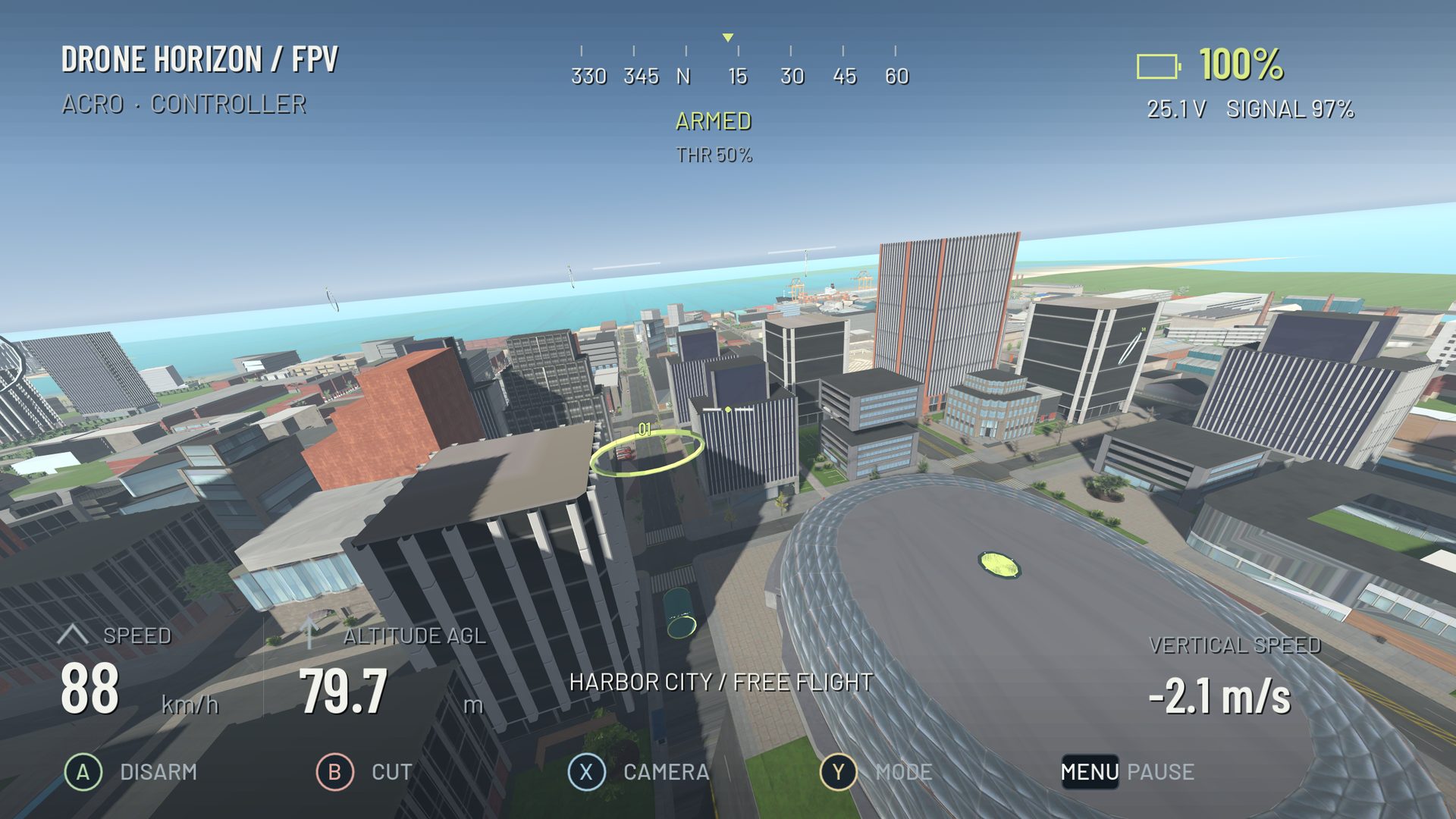
Good throttle control starts with watching vertical movement, not searching for one magic stick position. A manual FPV aircraft needs enough upward thrust to balance its weight, and that balance changes as you bank, accelerate or use the battery. Half stick is not a universal hover command.
In Drone Horizon, Standard manual flight and FPV/Acro use collective control. The separate DJI-style stabilized flight family manages height differently. Choose the manual family for the exercises below; otherwise an altitude controller may hide the skill you are trying to practice.
Establish a usable range first
Before flying, inspect the throttle channel from its lowest position to its highest. It should cover the expected range continuously, without jumping from zero to full power. A reversed channel, missed calibration endpoint or throttle bound to a button can make ordinary takeoffs look like a physics problem.
A spring-centered gamepad deserves special attention: releasing the stick returns to its mechanical center, not necessarily to minimum thrust. A radio throttle may remain where you put it. Drone Horizon's normal manual touchscreen throttle also retains its position. Learn your device's release behavior while disarmed.
Exercise 1: climb, settle, descend
Use an open area and a fixed aircraft. Start upright, set minimum throttle and arm. Increase collective gradually until the aircraft leaves the ground. Allow a modest climb, then reduce slightly before reaching your chosen practice height. Watch whether the ground is still moving away; reaching the desired height does not mean the climb has stopped.
Hold a small visual altitude band, then descend deliberately. Arrest the descent above the landing surface before trying to touch down. Repeat until you can distinguish three states: moving upward, nearly level and moving downward. Record how often you need a large corrective input. The goal is fewer abrupt corrections, not a specific percentage on the throttle bar.
Exercise 2: keep height through a wide turn
Fly a broad, shallow turn at a repeatable entry speed. Banking redirects some thrust sideways, so unchanged collective may allow height to fall. Add a small amount as the bank develops, then ease it out as you level. Making the throttle change after a large drop means you must recover both height and downward momentum.
| What you see | Likely practice adjustment |
|---|---|
| Climb begins after every correction | Make smaller changes and allow time to observe them |
| Height falls mainly in corners | Coordinate throttle with the developing bank |
| Aircraft launches when a gamepad is released | Check spring-centering and the throttle mapping |
| Only the top half of travel changes thrust | Recheck endpoints and whether a trigger-style mapping was selected |
Why hover drifts during a session
Different simulated aircraft have different mass, thrust and battery characteristics. Drone Horizon includes battery-dependent motor output, so the same stick position need not produce identical lift throughout a session. Resetting between comparisons and keeping the aircraft constant makes early practice easier to interpret.
Throttle expo can spread useful control around a region of the stick, but it cannot turn manual collective into altitude hold. Fix calibration before tuning the curve. See expo explained when basic movement is already predictable.
A useful finish criterion
Finish this drill when you can make several calm climbs and descents, maintain roughly the same height through both left and right turns, and land without a final throttle jab. Then combine it with pitch and roll coordination. All suggested heights and repetitions are simulator exercises, not clearance rules for real-world flying.