
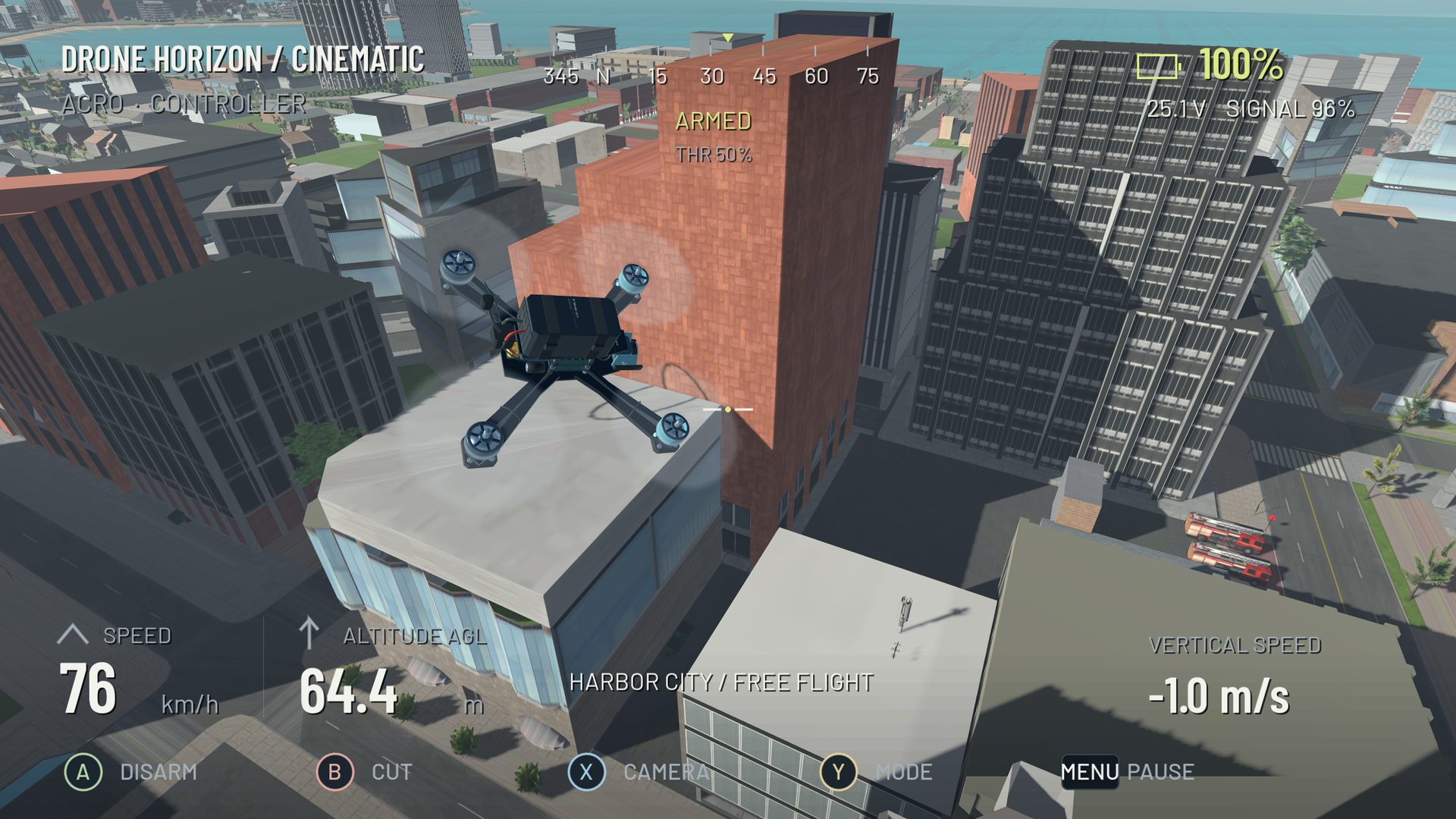
A motor-driven rigid body
Drone Horizon represents the aircraft as a rigid body and applies forces at four motor positions. Motor response, reaction torque, aircraft inertia, drag and battery-dependent output all contribute to motion. The pilot does not trigger a canned trajectory when making a turn or freestyle maneuver.
In manual modes, the flight controller turns input into desired attitude/rates and collective. The motor mixer allocates commands within the available motor limits. The separate stabilized family adds movement and hold control before reaching the same aircraft actuation model.
What the individual systems contribute
| System | Role in the model |
|---|---|
| Motor spool response | Requested output is not an instantaneous physical force |
| Motor positions and inertia | Aircraft geometry affects torque and angular response |
| Drag and relative airflow | Movement depends on air-relative velocity |
| Battery model | Available motor output changes with simulated electrical state |
| Collision and damage | Impacts affect motion and aircraft condition |
| Rate controller and mixer | Requested rotation must fit available control authority |
These are verified implementation mechanisms. The fictional fleet's numbers are configurable simulator specifications, not a published set of measured thrust-stand results.
Precision is an explicit performance choice
The current settings offer Standard 120 Hz, High 250 Hz and Maximum 500 Hz physics precision. Higher update frequency increases simulation work and is separate from render FPS. The presence of a 500 Hz option does not certify performance on every PC or phone.
Use a stable baseline and compare the same maneuver before drawing conclusions. A higher precision setting cannot repair wrong input calibration or missing collision geometry.
Approximation boundaries
Wind, ground effect and wake-related behavior are represented through bounded simulation models. They are not computational fluid dynamics or a guarantee that a specific real aircraft will react identically. The simulated radio-strength display is also a gameplay estimate rather than physical RF measurement.
The current code includes DJI-style stabilized braking and hold behavior. Older manual-only documentation no longer describes every flight family. The website therefore distinguishes control modes explicitly instead of claiming that assistance is absent everywhere.
Inspect the response
The telemetry overlay and CSV blackbox expose inputs, requested/actual rates, motor values, velocity, battery state and other flight signals. Use them to ask a focused question: whether a command arrived, whether the aircraft reached the requested rate, or whether a recovery remained limited by momentum.
Begin with the physics learning hub, then use telemetry for a repeatable experiment. Simulator inspection improves understanding of the model; it does not replace real-aircraft testing or turn a practice result into a safety certification.