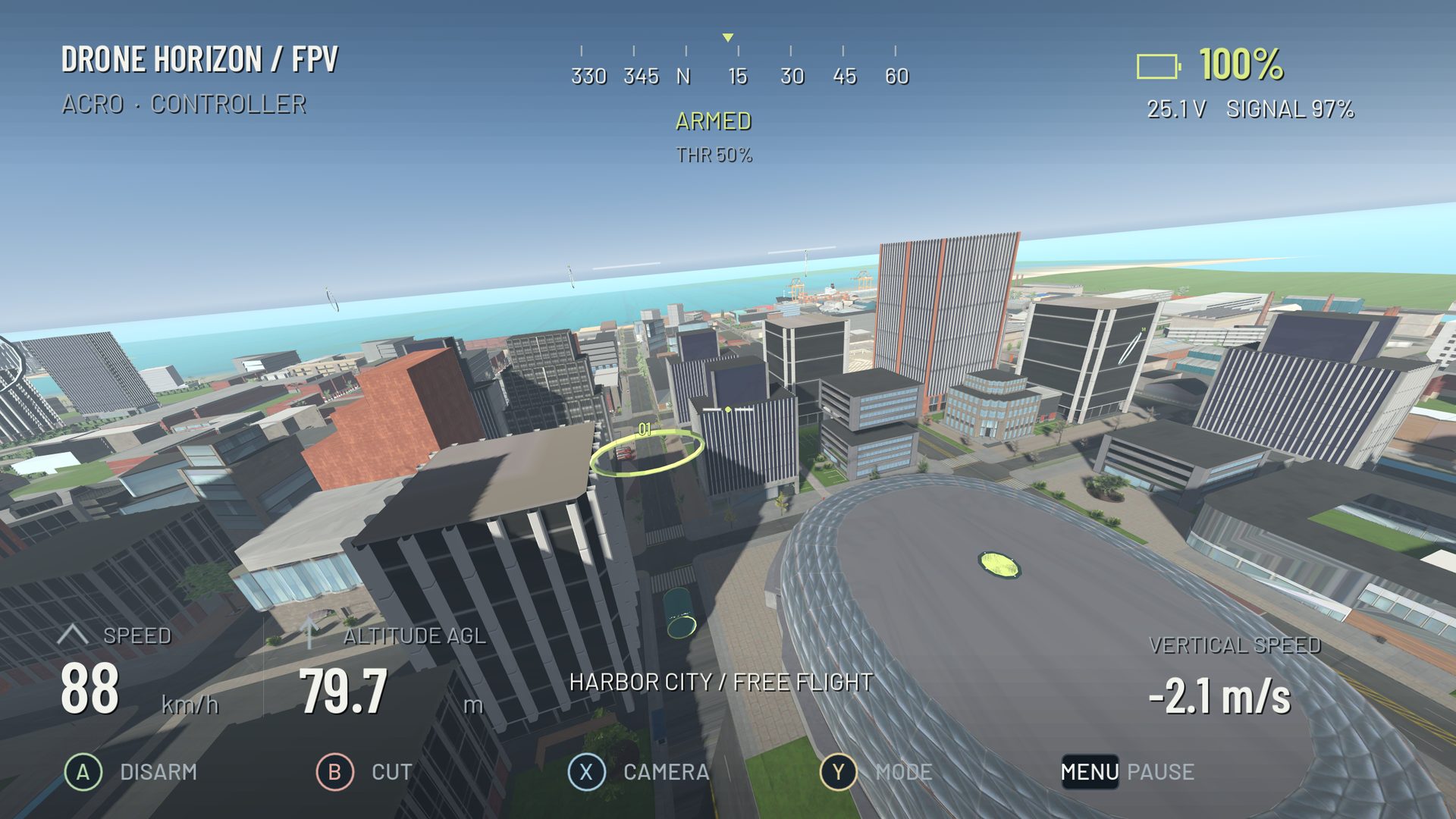
The difference between Angle and Acro is what the right stick asks the aircraft to do. In Angle mode, pitch and roll ask for a tilt angle; release the stick and the controller tries to bring the drone back toward level. In Acro mode (also called Rate mode), pitch and roll ask for a rate of rotation; release the stick and rotation stops, but the drone stays near its current attitude.
That single difference changes how you make every turn, recovery and landing. Betaflight's flight-mode guide describes the same core distinction in its real flight-controller modes.
| Question | Angle | Acro / Rate |
|---|---|---|
| What does pitch/roll stick position command? | A tilt angle | A rotation rate |
| What happens when you center the stick? | Returns toward level | Stops commanding rotation; attitude remains |
| Can you invert the aircraft through normal stick input? | Generally limited by the mode's angle constraint | Yes, if the aircraft has room and sufficient control authority |
| Best early use | Orientation and basic lines | Manual FPV, racing and freestyle |
Throttle is separate. Neither mode automatically means altitude hold. Some aircraft combine leveling with other assistance, but do not assume that a centered throttle will hold height. In Drone Horizon's manual modes, the pilot controls throttle throughout.
Why Acro feels difficult at first
A new pilot often treats the right stick as a direction pad: push forward to go forward, then let go to stop. In Acro, pushing forward starts pitching the drone; letting go stops the commanded pitch rotation, not the forward tilt or the resulting acceleration. To level the aircraft, you need a short opposite input. The same applies to roll.
That is why a novice may accidentally build more and more bank into a turn. The fix is not frantic opposite stick. It is to make smaller inputs early enough that you can see the attitude change and deliberately unwind it.
A transition exercise
- In Angle mode, fly a large slow rectangle and hold a steady height through every corner.
- Switch to Acro in an open area. Take off, then make a tiny right-roll input and release it. Observe the new bank.
- Add a tiny left-roll input until the horizon is level again. Repeat on pitch.
- Fly one straight line, then a broad turn. Focus on setting and removing a bank, not on speed.
- If you lose orientation, reset the session. Reduce your input size for the next attempt.
Do not change camera angle, rates and aircraft at the same time as the mode. Keep those variables fixed until the difference in stick behavior is clear.
Where Horizon mode fits
Horizon is a blend: it self-levels near centered sticks and allows more rate-like behavior as stick deflection increases. It can be a useful bridge, but it is not a substitute for learning what Acro's non-leveling center means. Implementations differ by flight controller and configuration, so use the manual for the actual aircraft. Betaflight's current Modes documentation explains its Horizon behavior.
Practice in Drone Horizon
Drone Horizon exposes Angle, Horizon and Acro in the same simulated flight model. That makes it possible to fly the same route in each mode and compare your inputs directly. Begin with the control axes guide, then follow the FPV path or freestyle path once you can level the aircraft deliberately in Acro.