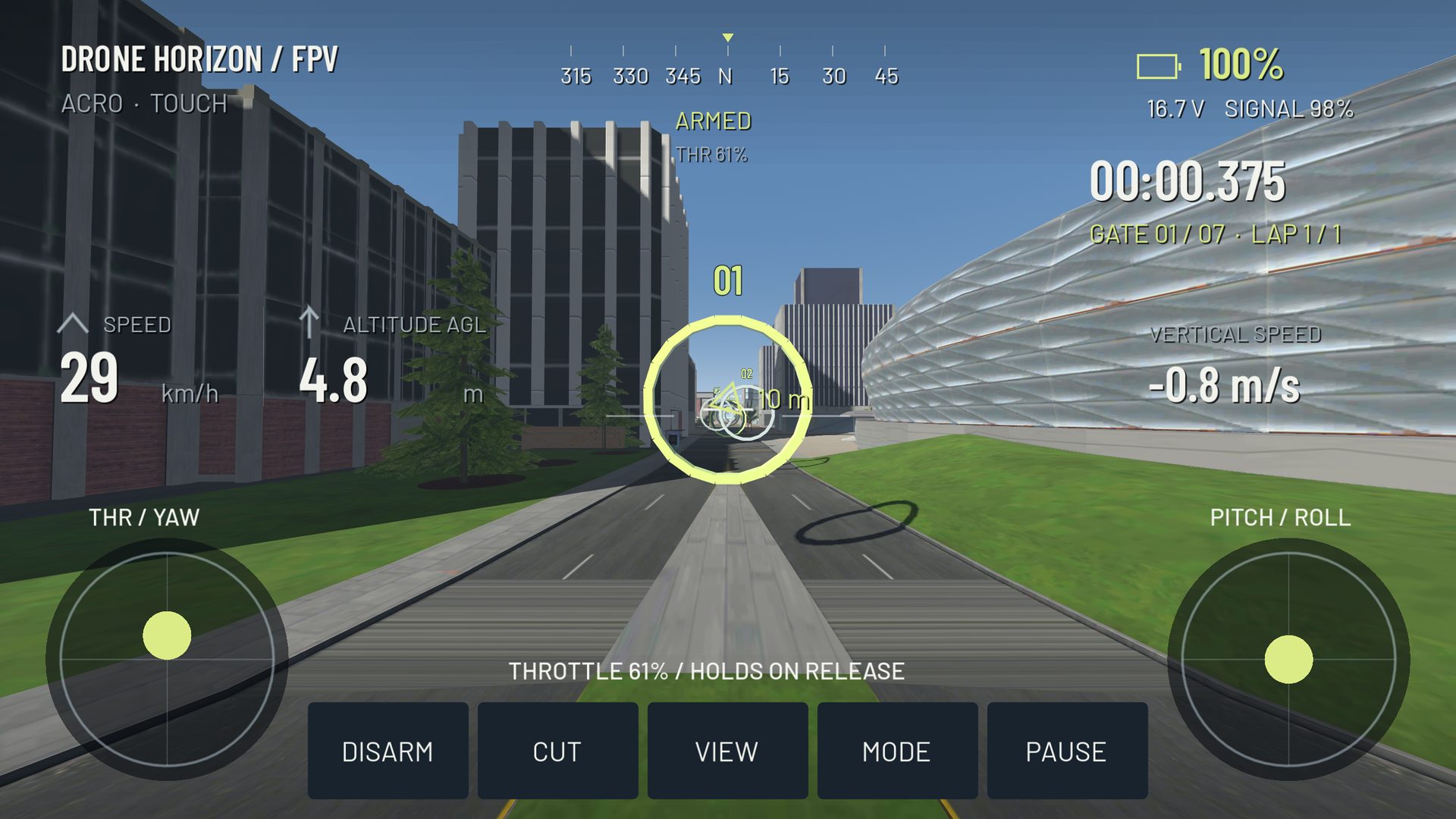
A drone simulator is a flight practice environment. You command a virtual aircraft with sticks or touch controls, see how it moves, and try again without repairing a real quadcopter after every mistake. The useful part is not that the screen looks like a flight. It is that your input has consequences you can learn to predict.
A good practice session asks a specific question: Can I lift off without a surge? Can I keep the nose pointed away? Can I pass a gate without making a last-second correction? Those are skills you can repeat until they feel familiar.
What a simulator can teach
The first lesson is the relationship between the four control axes. Throttle changes lift, yaw rotates the nose, pitch tilts forward or back, and roll tilts sideways. Moving one axis in isolation is useful at first; actual flight requires coordinating them. Our visual guide to throttle, yaw, pitch and roll is a good place to start.
A simulator also lets you practice orientation. A left turn looks different when the aircraft is flying toward you than when it is flying away. In first-person view, the camera removes that outside reference and makes line choice more important. Repeating both views helps you recognize what the aircraft is doing before you add speed.
Finally, it makes errors visible. You can replay the same gate, landing area or corner and change one input at a time. That controlled repetition is difficult to arrange with a real aircraft, limited batteries and changing wind.
What it cannot teach on its own
No simulator is a perfect copy of a particular airframe, radio link, propeller or weather condition. A model can represent forces and controller response, but real hardware has its own latency, camera characteristics, battery behavior and failure modes. A screen also cannot teach you site assessment, airspace awareness, bystander safety or the physical habits of handling batteries and props.
Treat virtual flight as stick and decision practice, then approach a real aircraft cautiously with the real manual and local requirements in hand. Do not assume that being able to recover in a game makes a risky real-world maneuver safe.
A useful first session
- Pick one aircraft and one open area. Keep the same control layout for the entire session.
- In a self-leveling mode, arm with throttle low, raise it gradually, and hold a steady hover. Watch how small throttle changes alter height.
- Yaw 90 degrees at a time while holding position. Stop, reorient, and repeat.
- Fly a slow rectangle: short forward leg, turn, short sideways leg, turn. Land deliberately.
- Only after the rectangle is repeatable, switch to an onboard camera or a less assisted mode.
The aim is not to avoid every crash. It is to understand why the previous attempt failed. If you overshoot a corner, change your entry speed before changing your rates or aircraft.
How Drone Horizon fits
Drone Horizon has touch controls, compatible controller input, assisted and Acro flight modes, a guided flight, free flight, and timed gates. Its aircraft use a rigid-body flight model with independent motor forces, drag and battery effects. Those details make it useful for practicing input timing and momentum; they do not make it a certification or a substitute for flying an actual aircraft.
Begin with Flight School, then use the FPV beginner guide when you are comfortable controlling the drone from outside.
Sources and further reading
- Betaflight: Modes explains the difference between self-leveling Angle and rate-based Acro control.
- ArduPilot: radio calibration documents Mode 1 and Mode 2 stick layouts and calibration checks.