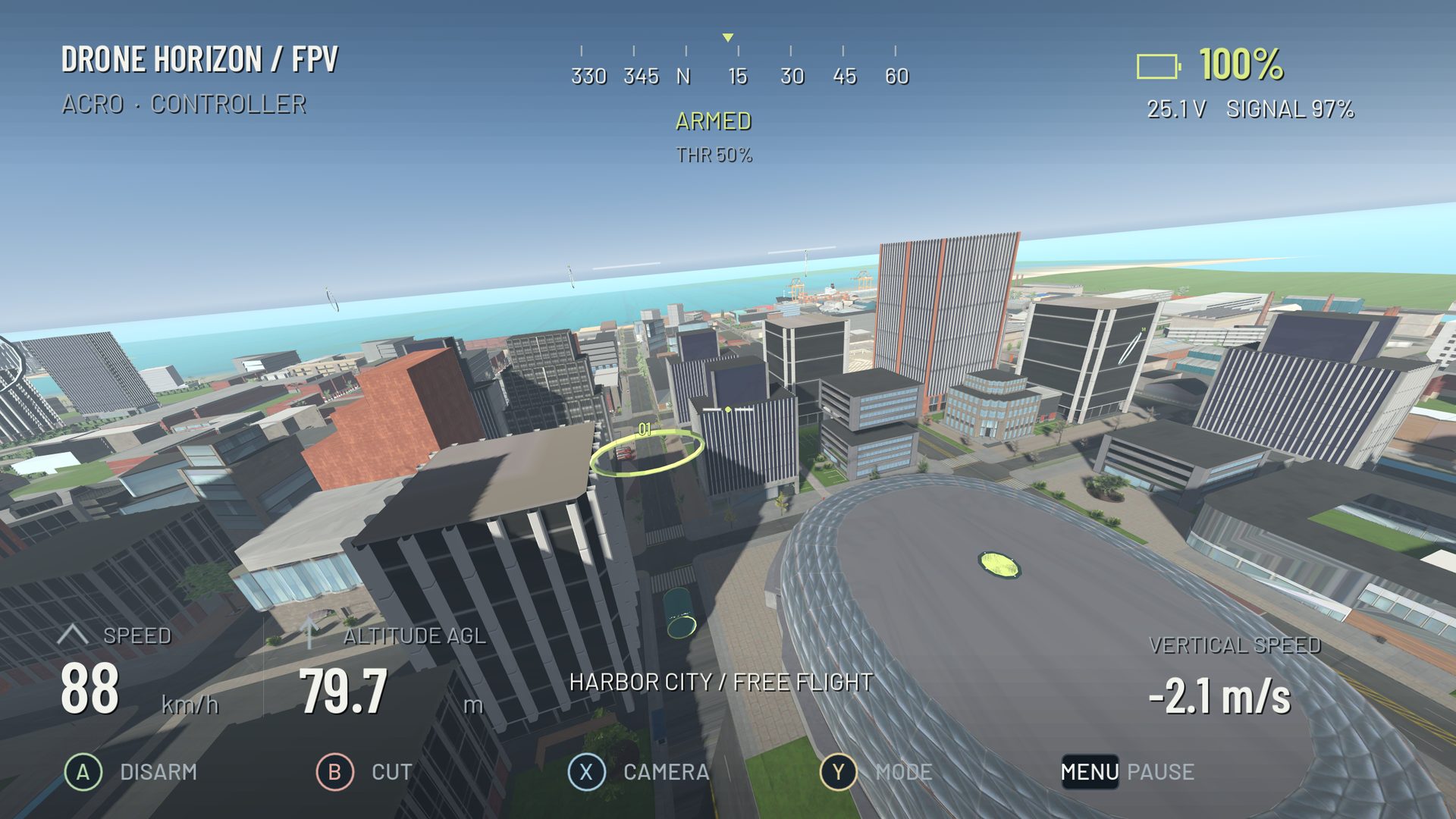
FPV means first-person view: you steer while looking through a camera mounted on the drone. The outside view disappears. You judge height, speed and direction from the camera image, the horizon and how scenery moves across the frame. That change in perspective is why a confident line-of-sight pilot can feel lost on the first FPV flight.
A simulator gives you the time to build that visual judgment. Start with a large open route. The point of the first session is to keep the aircraft moving where you intended, not to thread the smallest gap on the map.
Set up before taking off
Choose a control layout and verify all four axes before arming. In common Mode 2, the left stick carries throttle and yaw; the right carries pitch and roll. If a physical controller is connected, check that each axis moves in the expected direction and that the stick centers are stable. See Mode 1 versus Mode 2 if your layout is unfamiliar.
Begin with moderate camera tilt. A steeply upward camera angle can make the drone's attitude harder to read at low speed; a flatter view makes the horizon easier to use. In Drone Horizon, camera tilt can be adjusted, and the FPV camera follows the aircraft's physical attitude. Keep that setting fixed while you learn a route so the visual cues remain consistent.
The first three FPV exercises
1. Hold a level, slow line
Take off in an open area and fly forward at a speed you can stop from. Pick a distant landmark and keep it near the middle of the screen. Make small corrections, then release the stick long enough to see the result. If you constantly wag the nose left and right, slow down and separate yaw from roll practice.
2. Make a wide turn
Approach a visible corner. Roll gently into the turn, add yaw to point the camera where you want to exit, and manage pitch and throttle so the aircraft does not sink. The useful cue is the exit: look there early. If you only watch the obstacle nearest the camera, your corrections will arrive late.
3. Fly the same line twice
Pick two landmarks and fly between them. Repeat without changing aircraft, rates or camera angle. Compare the two approaches: Did you enter at the same height? Did you start the turn at the same point? Consistency gives you a baseline before speed.
Angle or Acro?
Angle mode self-levels when you release pitch and roll. It can help you learn the FPV image without also managing attitude continuously. Acro, or rate mode, does not self-level; the stick commands rotational rate. Many FPV racing and freestyle skills depend on that manual attitude control. Move to Acro once you can hold a line and recognize when the aircraft is tilted, then return to a wide open route. Our Acro versus Angle guide explains the transition in detail. Betaflight's mode documentation is a useful reference for the real flight-controller behavior.
What to practice next
If you want speed, use a gate practice sequence. If you want tricks, start with freestyle recovery and altitude control. Both depend on the same foundation: clean inputs at a speed that leaves you enough time to notice the aircraft's response.
You can work through these steps in Drone Horizon's FPV flight and follow the FPV learning path. A simulator makes repetition cheap. It does not remove the safety and site judgment required for real FPV operations.