
There is no defensible universal number of simulator hours that makes every beginner ready for FPV. Previous controller experience, practice quality, chosen flight mode and the task itself all matter. Counting time can help you maintain a habit, but it cannot tell you whether the habit is teaching the right thing.
Use milestones that describe what you can do deliberately. “Fly three calm circuits in either direction” is a more useful target than “reach ten hours,” because it exposes a control skill rather than elapsed time.
Separate familiarity from control
The first sessions often go into finding the sticks, learning arming and understanding what Acro does when you center an input. That is valuable orientation. It is different from being able to set a bank, maintain height and remove the bank on an intended exit.
If the same mistake happens repeatedly, do not assume another hour on the same full course will solve it. Break the problem down. A recurring drop at a corner may need a throttle-and-bank drill; a missed gate may begin with the exit of the previous one.
Use a progression checklist
| Skill | Evidence you can observe |
|---|---|
| Input familiarity | Correct axis chosen without looking at your hands |
| Vertical control | Gentle climbs, descents and landings |
| Attitude control | Small banks established and removed intentionally |
| Route control | Similar path clockwise and counterclockwise |
| Recovery | Small mistakes corrected before becoming emergencies |
| Gate sequence | Clean exits as well as successful entries |
These are suggested practice checks, not a certification standard. Keep the environment generous while learning them. Making a task tighter increases difficulty but does not necessarily increase learning if most attempts end before you can observe the problem.
Short sessions can be productive
A focused session begins with one objective, uses a consistent setup and ends with one observation. Stop or take a break when attention and grip deteriorate. Tired corrections can become larger and less deliberate, making it harder to judge whether a settings change helped.
The 30-minute routine is one way to structure a block. You can shorten or extend it; the important feature is separating warm-up, isolated practice and application to a route.
Avoid resetting your setup constantly
A different aircraft, camera angle, rate model and controller all change the task. Exploring settings is useful when it answers a specific question. Changing several after each crash removes the stable reference your hands are trying to learn.
Keep a named baseline and write down intentional changes. If the raw axis values are wrong, fix them immediately. If the setup is correct but a turn is difficult, give the exercise enough repetition before blaming the configuration.
How Drone Horizon can support a progress check
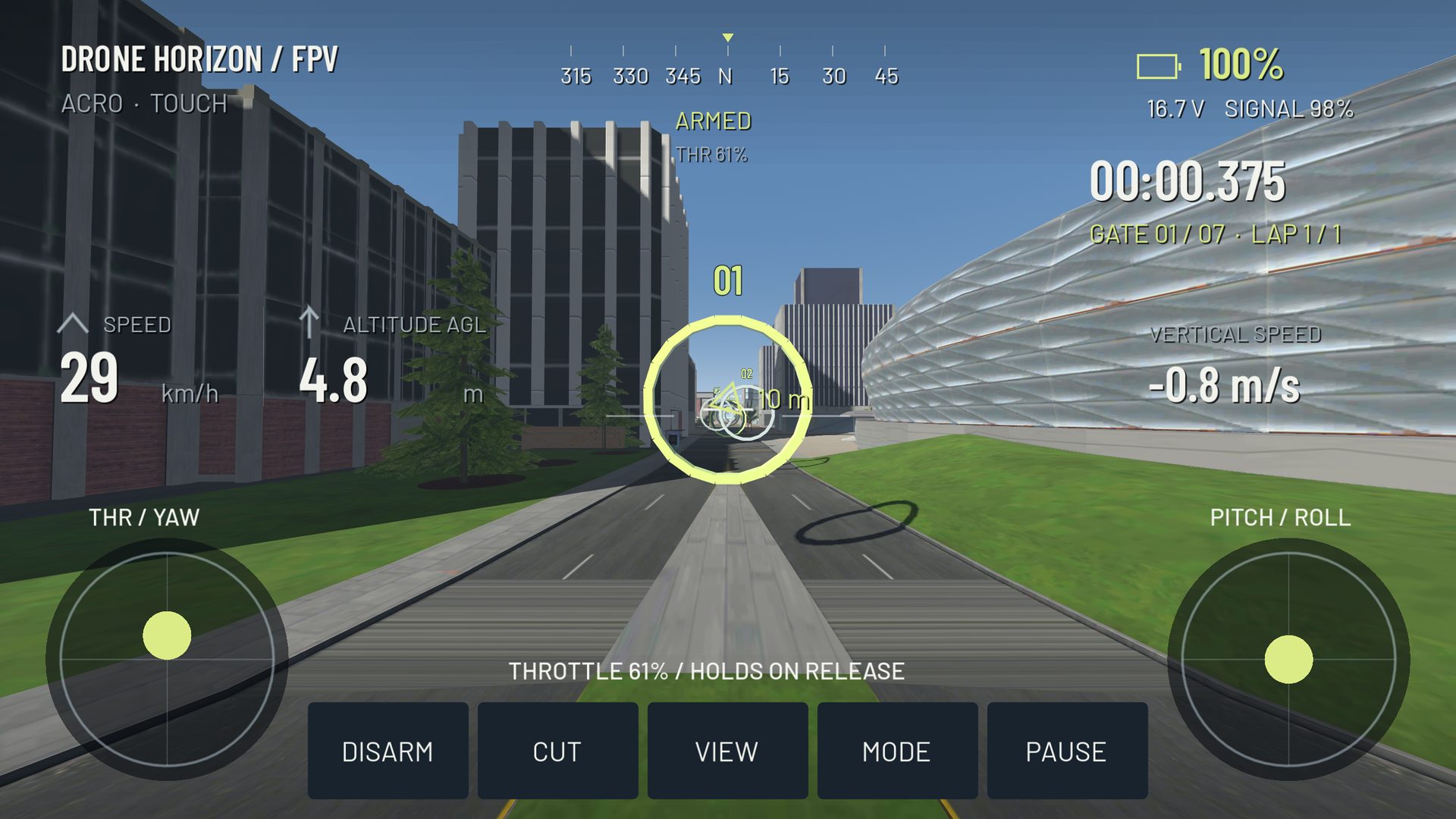
The game includes a guided Flight School, timed sessions, gate progression and landing challenges. These provide concrete tasks and visible outcomes. A timer or medal is still only evidence about that session; it does not establish real-world readiness.
Use Flight School to learn the interface, then repeat a simple route without prompts. For transfer beyond the simulator, review simulation versus real training. Your strongest progress signal is being able to explain a mistake and repeat the correction calmly, not reaching a round number in a playtime counter.