
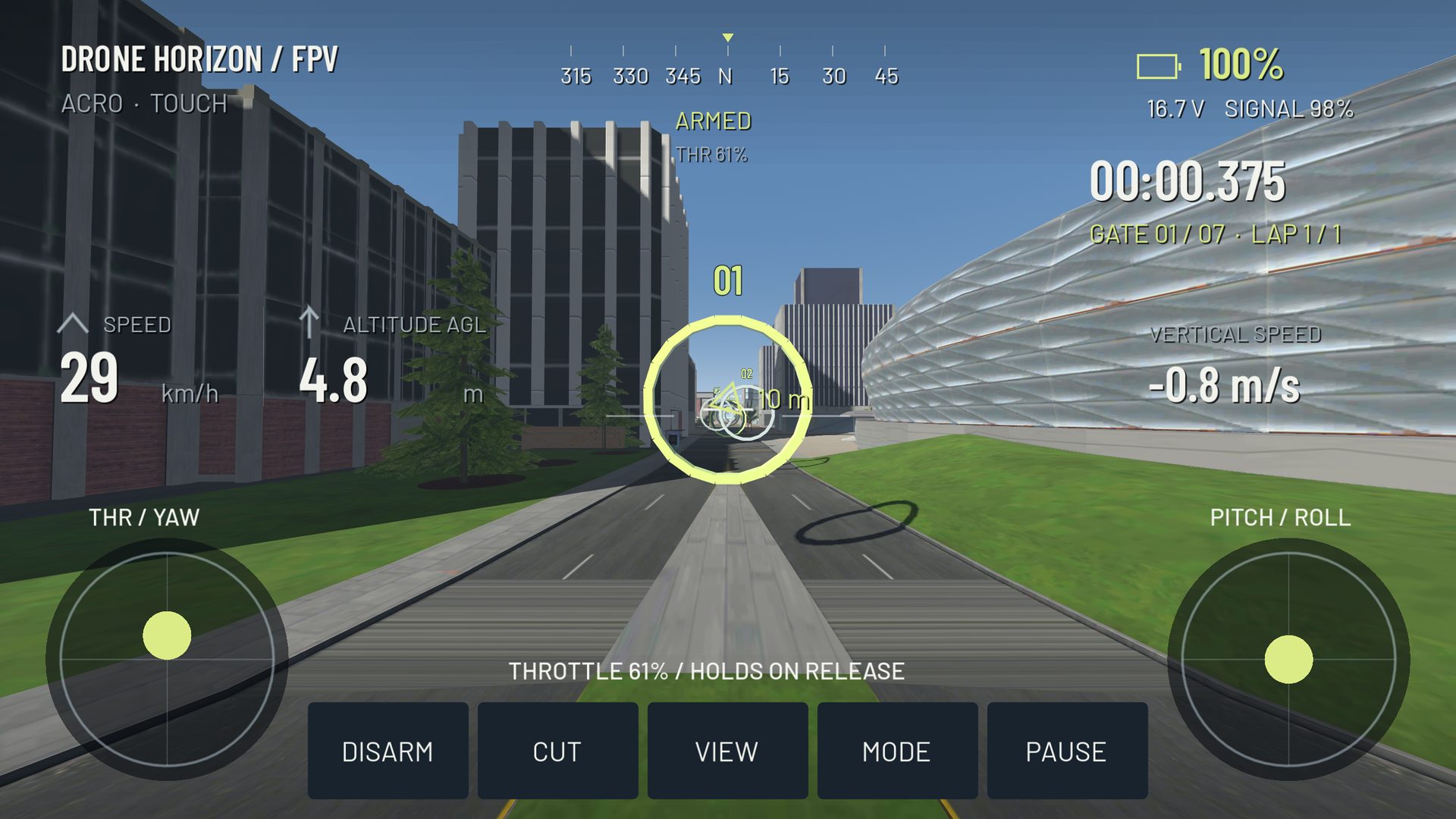
A precision landing begins before the drone is directly above the pad. You need to reduce horizontal movement, align with the landing area and control descent. Trying to solve all three in the final instant usually creates a bounce, slide or sudden climb.
Use a large virtual landing area first. Keep the approach direction and aircraft consistent so you can compare attempts. A smaller target is useful only after you can repeat the sequence without a last-second rescue.
Slow the approach before descending
Approach at a manageable height and reduce forward movement with enough room to observe the response. In manual FPV, returning the body toward level does not immediately stop it. You may need a separate attitude change to brake before establishing the descent.
Once the target stays in a predictable position, begin lowering collective gradually. Watch ground movement and the aircraft's vertical speed if available. Descending faster makes late corrections more demanding because you must arrest downward momentum as well as reduce height.
Keep the camera's geometry in mind
An upward-tilted FPV camera can lose sight of nearby ground during a level or nose-up approach. Do not interpret the target leaving the frame as proof that the aircraft is already over it. Use the visible surroundings and choose a camera setup suitable for slow practice.
An outside view can help diagnose whether you are sliding across the pad. Return to FPV afterward and identify the cues that correspond to that movement. The camera angle guide explains why landing can feel different after a tilt change.
Separate three checks
| Phase | Useful sign | Common mistake |
|---|---|---|
| Braking | Horizontal movement is manageable | Descending while still arriving too fast |
| Alignment | Target position changes slowly | Chasing the pad with large roll/yaw corrections |
| Touchdown | Low speed and upright contact | Cutting collective too early above the surface |
After contact, disarm deliberately according to the simulator's controls. A spring-centered throttle can reapply output if you simply let go, so verify that behavior before practicing repeated landings.
What Drone Horizon scores
The Landing Challenge uses pad proximity, low linear speed, upright attitude, actual ground contact and a continuous dwell period. A valid touchdown must persist rather than merely pass through the target. Its first landing stage also requires a genuine departure before it can score.
That makes the challenge different from touching a visual marker at speed. The current logic advances through the map's landing pads, and map availability matters. These are game rules, not professional landing-certification tolerances.
A repeatable practice block
Make several approaches from the same direction, ending with a calm touchdown and disarm. Then try the opposite approach. If one direction is harder, investigate the view and the required turn rather than immediately reducing the target size.
When the sequence is reliable, add a gentle cross-route approach or use another appropriate pad. Keep the height and speed manageable. For control foundations, return to throttle practice and pitch/roll coordination. A precise landing is the result of a controlled approach, not a special correction performed at the ground.