
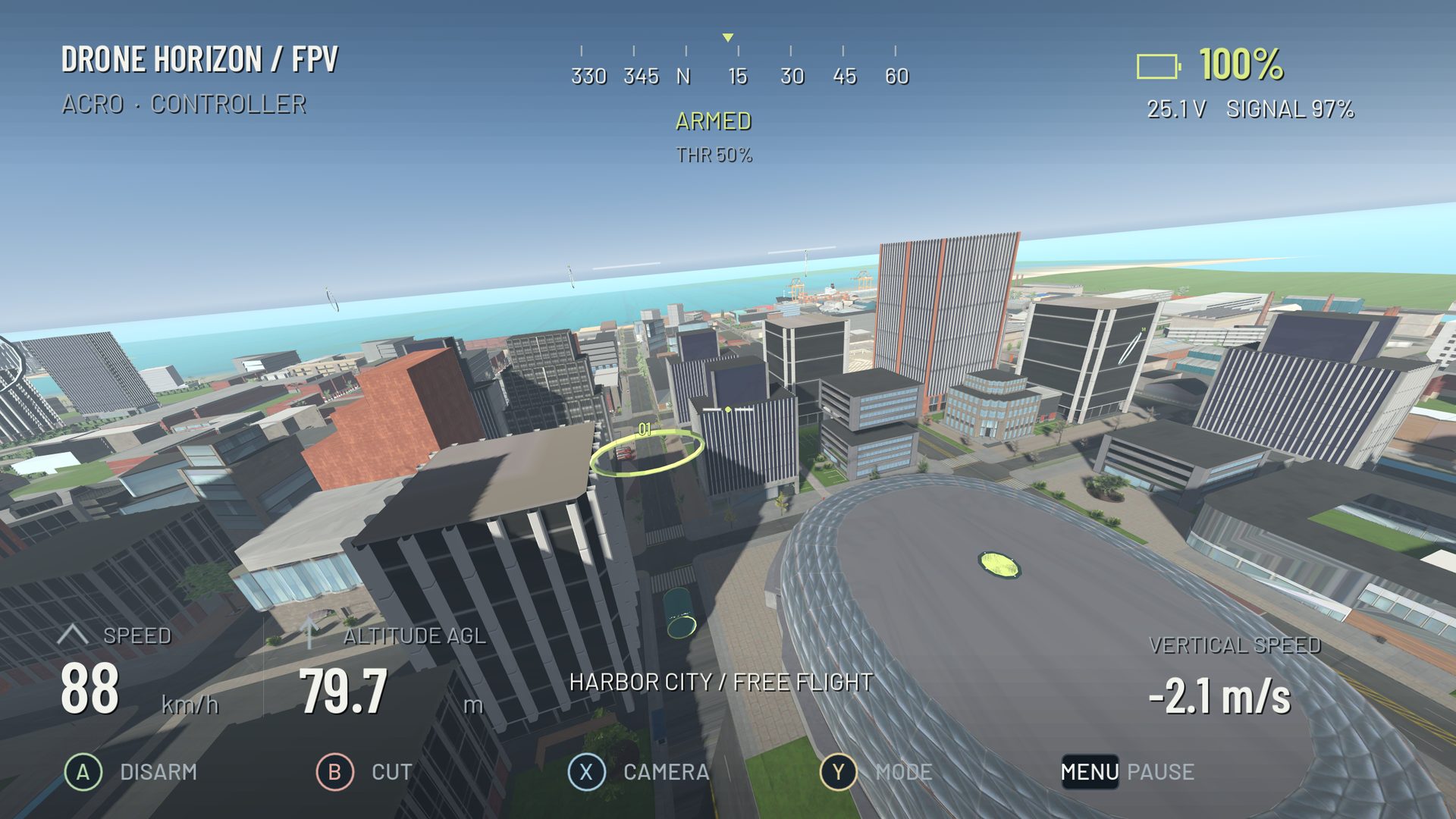
FPV camera angle is the upward tilt of the camera relative to the aircraft. It changes what you see when the drone pitches forward. It does not directly change the drone's thrust, maximum speed or rotation rates.
A tilted camera can look toward the horizon while the aircraft is leaning forward. That makes a forward route easier to see during fast flight, but it can make slow flight and landing less intuitive. Choose an angle for the exercise rather than treating a larger number as an upgrade.
Why the horizon can mislead you
Imagine a camera mounted with some upward tilt. With the aircraft level, the view points above the aircraft's straight-ahead body direction. Pitch the aircraft forward and the camera can approach a level view even though the motors' thrust vector is now tilted.
This is why “the horizon is centered” does not necessarily mean “the aircraft is level.” If the aircraft continues accelerating with centered sticks, check its attitude and your flight mode. In Acro, centered pitch stops requesting more rotation; it does not automatically undo the forward tilt.
Select an angle for the task
| Task | Useful priority |
|---|---|
| First takeoffs and landings | Keep nearby ground references easy to understand |
| Broad beginner circuits | Balance forward visibility with readable height cues |
| Fast gate approach | See the upcoming line while pitched forward |
| Close cinematic movement | Preserve subject framing at the intended speed |
You do not need one permanent angle for every task. You do need consistency while learning a particular task. Changing it after each difficult lap makes it harder to distinguish a technique problem from a changed view.
A controlled comparison
Save the starting angle. Fly a slow straight line, a wide turn and a gentle landing approach. Increase the tilt by a small amount, then repeat the same sequence with the same aircraft and rates. Notice where the horizon sits during steady forward movement and how early the landing area leaves the frame.
Return to the original angle for a final pass. Keep the change only if it improves the route you are actually practicing. If you find yourself accelerating simply to make the view look level, the new tilt may be encouraging more speed than the exercise needs.
Tilt is not field of view
Tilt rotates the camera. FOV changes the angular width or height visible through it. A wider FOV can make distant gates look smaller and increase peripheral visibility without changing the camera mount angle. Adjust them separately; see FPV field of view before copying another pilot's value.
Likewise, a stabilized gimbal may maintain a level view while the body banks. That is different from a rigid FPV camera, where the view follows aircraft attitude.
Drone Horizon's two camera behaviors
The project includes a rigid FPV mount with adjustable tilt and a separate stabilized camera/gimbal system for DJI-style flight. FPV camera behavior is tied to the aircraft; the stabilized family is designed around camera-drone framing. A setting that feels natural in one should not be assumed to mean the same thing in the other.
For manual practice, keep the FPV camera fixed while learning to set and remove bank. Use smooth turns to build that habit. For filming-style movement, read the stabilized flight guide and compare the view with what the aircraft is physically doing.