
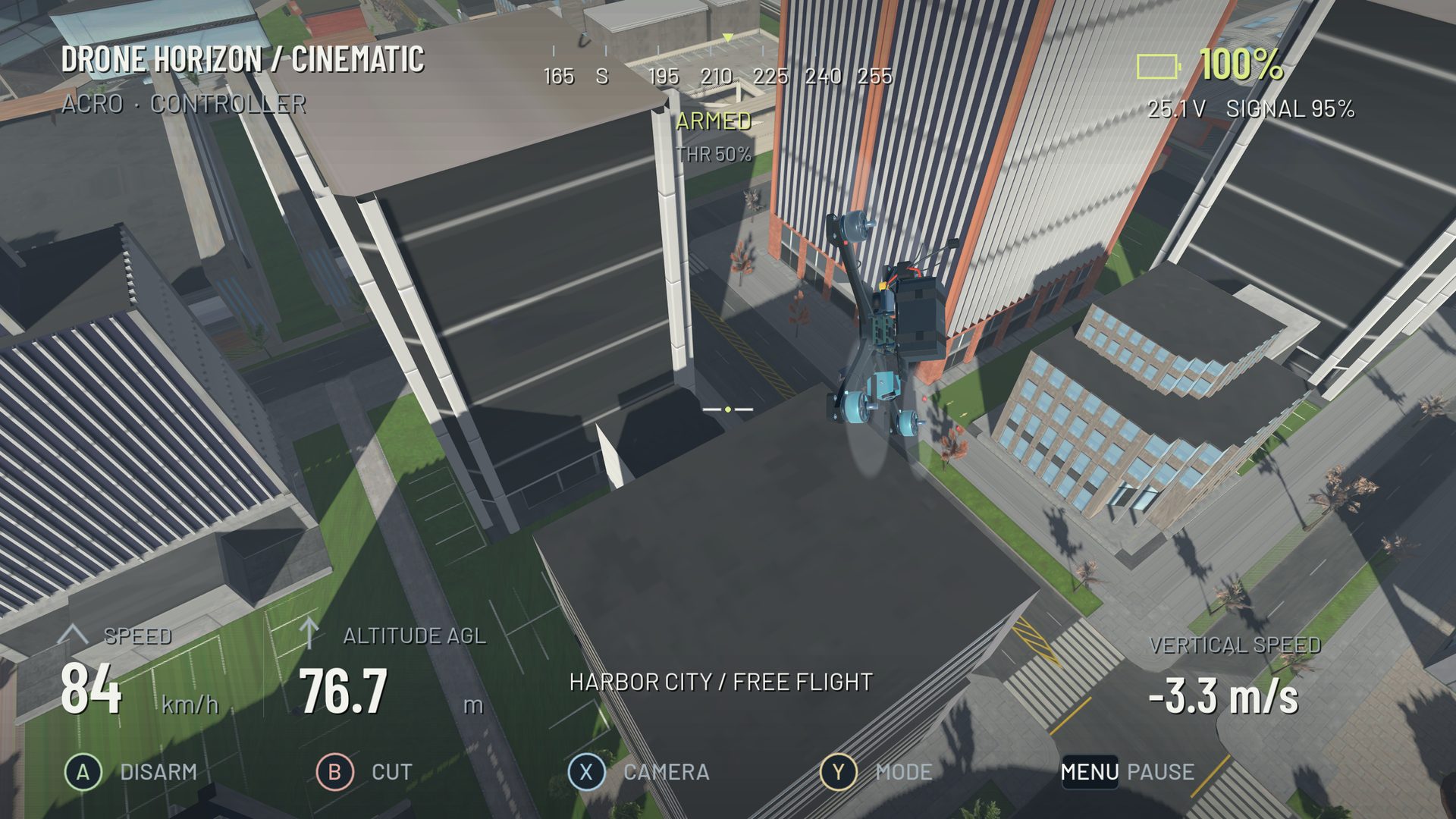
A Split-S starts with a half-roll to inverted flight, followed by a descending pitch arc that changes the aircraft's direction. It trades height for a new trajectory. The key learning task is staying oriented through the inversion and completing the recovery before the available space disappears.
Practice in open simulator airspace. A visually impressive building dive is a poor first version of the task because the obstacle hides whether the underlying roll, pitch and recovery are controlled.
Separate the two rotations
First practice a half-roll and identify the inverted attitude. Then reset and repeat in the other direction. Learn to stop the roll deliberately instead of continuing through a full roll by accident.
Next study a descending pitch arc separately with ample virtual height. In Acro, pitch commands body rotation; the correct stick direction should already be verified in your input setup. If you are uncertain about inversion or axis direction, return to basic controls before attempting the combined maneuver.
Connect them with a known entry
Enter along a clear straight route at a repeatable speed. Perform the half-roll, then continue into the descending pitch arc and recover toward an upright exit. Keep the motions readable rather than trying to make the transition as fast as possible.
The exit should be planned before the entry. A completed rotation is not useful if the aircraft now faces a wall or carries too much downward velocity to maintain control. Leave a broad open corridor beyond the maneuver.
Account for momentum and thrust direction
The drone retains movement while it rotates. It does not trace a fixed semicircle simply because your pitch input is smooth. Throttle timing changes the arc, and thrust points with the aircraft rather than remaining upward in the world.
There is no universal minimum altitude or stick timing for every simulator aircraft. A light racing setup and a heavier long-range model can produce different trajectories. Begin with excessive virtual room, observe the path and make the task smaller only after it is predictable.
| Problem | What to isolate |
|---|---|
| Roll continues into the pitch arc | Half-roll stopping control |
| Exit heading is inconsistent | Entry alignment and unintended yaw |
| Recovery is upright but still plunging | Downward momentum and collective timing |
| Maneuver drifts sideways | Residual roll or lateral entry motion |
| Every attempt has a different shape | Inconsistent entry speed or changing setup |
Keep camera motion in perspective
An upward-tilted FPV camera can make the aircraft's actual attitude less obvious during recovery. Use a brief outside-view comparison if necessary, then return to FPV and identify the visual cues. Do not fix disorientation by randomly changing camera angle between attempts.
Drone Horizon's manual FPV family permits continuous rate-based rotation. Its stabilized camera-drone family is a different behavior and should not be used to infer a manual Split-S response.
Progress to a reference, not a trap
After repeatable open-air attempts, choose a large virtual reference that helps position the entry while leaving the descent and exit clear. Rehearse the recovery independently whenever the obstacle begins dominating your attention.
Use dive recovery for the final phase and power-loop practice to compare a maneuver that begins by building a climbing arc instead. Keep both as deliberate simulator exercises rather than shortcuts to real-world proximity flying.