
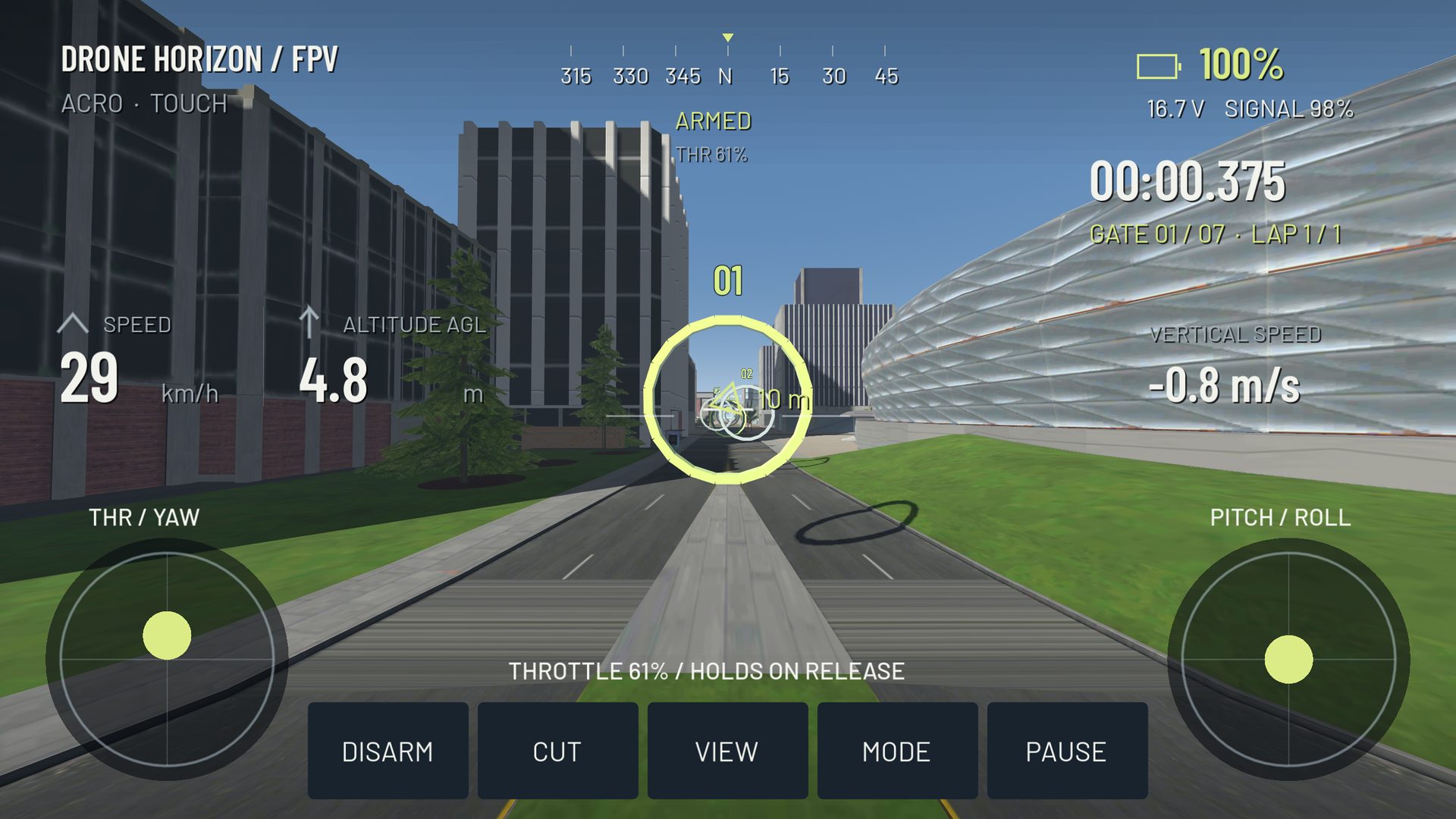
Thirty minutes is enough time to run a focused practice block if you spend it on one defined task. It is not a guaranteed learning dose. The purpose of this schedule is to prevent a session from becoming an uninterrupted series of crashes and settings changes.
Choose the skill before launching: steady height through a turn, a clean two-gate sequence, smooth framing or a controlled landing. Keep the aircraft and view constant for the entire block unless a genuine setup fault appears.
A session you can follow
| Time | Task | What to notice |
|---|---|---|
| 0–5 minutes | Input check and slow warm-up circuit | Drift, wrong axes, unexpected throttle behavior |
| 5–15 minutes | One isolated exercise | The same entry and a repeatable correction |
| 15–23 minutes | Apply it on a short route | Whether the skill survives a transition |
| 23–28 minutes | Repeat the route calmly | Clean runs rather than one risky best time |
| 28–30 minutes | Record result and next step | One specific observation |
The timings are suggested boundaries, not rules. If you discover a calibration fault during the warm-up, use the session to fix and verify it rather than forcing a practice target onto broken input.
Make the isolated exercise small
For throttle control, use a broad corner and try to preserve a consistent height. For yaw, stop the nose on a distant landmark. For gate practice, use one opening and a clear exit. For landing, repeat a straight approach from the same direction.
Choose a starting point and reset there when necessary. Changing your entry speed and approach angle on every attempt makes the results difficult to compare. A consistent setup lets you see whether the correction itself is improving.
Add just one transition
During the route block, connect the isolated task to something immediately before or after it. Follow a turn with a straight approach, or a gate with another gate. This exposes an important weakness: a maneuver may work alone but leave the aircraft badly positioned for what comes next.
If the transition fails repeatedly, shorten it. Practice the turn exit and next entry together without completing the whole course. The racing line guide uses this same idea for linked gates.
Record observations you can act on
“Bad at racing” is too broad. “Losing height at the second left turn” suggests a throttle-and-bank exercise. “Pitch output reaches full scale halfway up the stick” suggests calibration. “Clean laps are close, but one risky cut is faster” suggests comparing consistency rather than rebuilding the controls.
Use a simple note with the route, profile and one result. Manual counts are enough; a simulator does not need a dedicated analytics feature for this routine. Drone Horizon's timers and optional telemetry can add detail when the question is specific.
Adapt the block for a phone
Keep the warm-up long enough to settle thumb placement. Use a route with a clear center view and take a break if grip or attention deteriorates. A physical gamepad or radio changes the mechanics, so repeating the same routine after switching devices is more useful than assuming your previous fine control will transfer instantly.
End with a controlled landing rather than another high-risk attempt. For a longer progression, follow the beginner routine. If the goal is eventual real flight, read what simulation does and does not teach before treating a practice log as proof of readiness.