
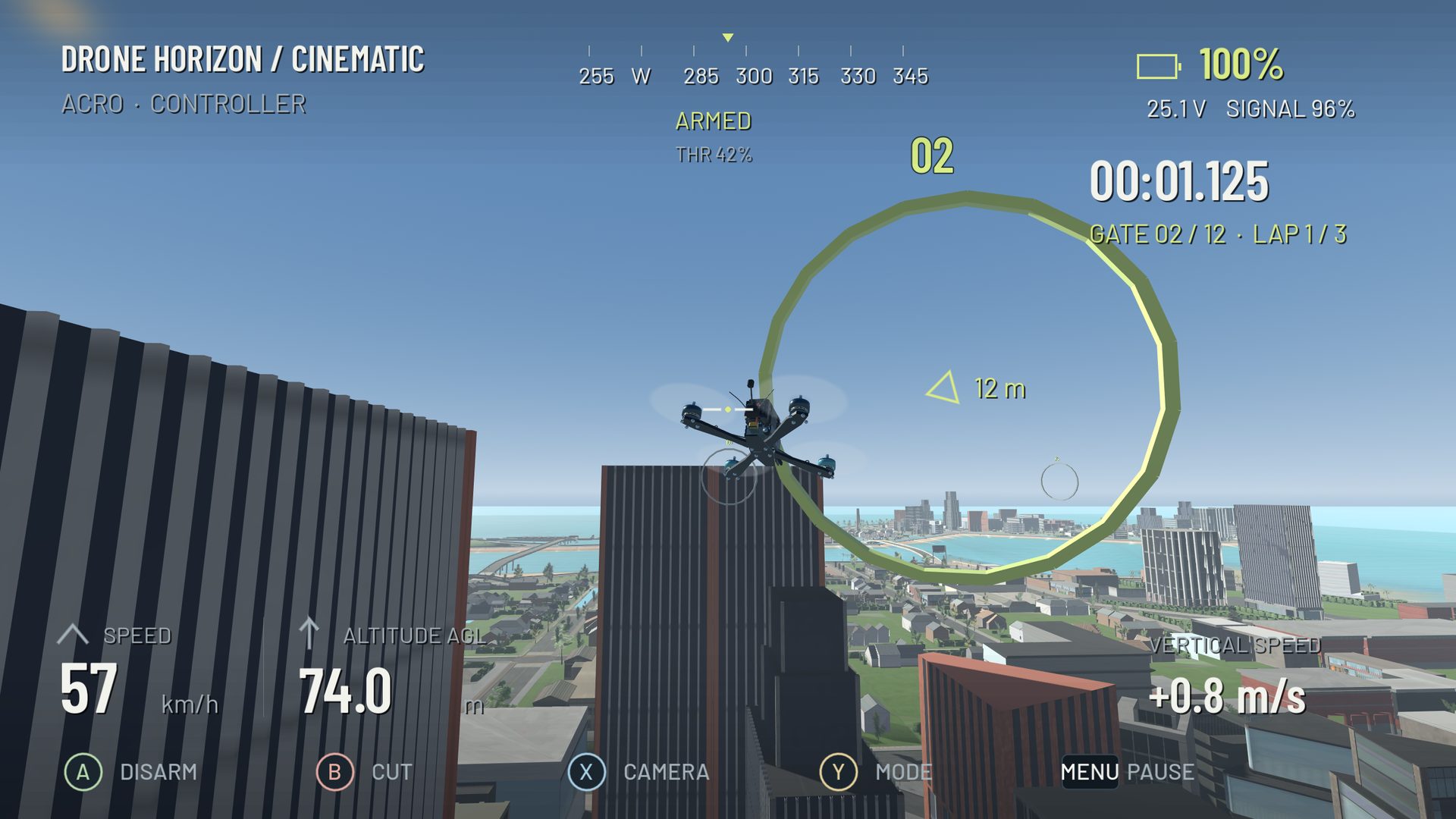
A slalom teaches the transition between opposite turns. The hard part is not simply banking left and then right; it is removing the first bank, crossing through a useful middle state and establishing the second without an abrupt height or speed change.
Use a broad, open simulator route with clearly separated landmarks. You do not need a built-in slalom challenge to practice the pattern. Two or three visible references are enough to define a safe virtual line.
Establish a gentle rhythm
Enter at a modest speed and bank around the first landmark. Before the next turn, begin unwinding the bank. Allow a brief, readable transition through near-level attitude, then establish the opposite bank. Keep the changes small enough that you can recognize each phase.
In Acro, a held roll input keeps requesting rotation. Centering it does not level the drone. The slalom therefore requires deliberate opposite input to remove the existing bank before building the next one. Review pitch and roll coordination if that sequence is unclear.
Use throttle through the transition
The amount of thrust directed upward changes as the aircraft banks and levels. If you carry all the extra corner throttle into the middle, the drone may climb. If you remove too much before the next bank develops, it may sink into the second turn.
Watch the height of a distant reference or the simulator's altitude display. Make small anticipatory changes instead of waiting for a large drop. Your initial goal is a consistent corridor, not a fast oscillation between maximum stick positions.
Find the origin of a repeated error
| Symptom | Likely place to examine |
|---|---|
| Each turn becomes tighter | Bank is still increasing when it should settle |
| Height rises between landmarks | Extra corner throttle remains as the aircraft levels |
| Second opening is always late | First turn exit begins the problem |
| One direction works better | Grip, unintended axis coupling or asymmetric practice |
| View rotates but path misses | Yaw is replacing needed trajectory control |
Do not fix every error by increasing roll rate. A faster command can make an unplanned transition even more abrupt.
Add gates only after the path is visible
Once you can repeat broad left-right arcs, use a course section with alternating openings. The frames add a position constraint, so return to a slower speed at first. Aim for a useful exit from each gate rather than making a dramatic correction exactly at its center.
Drone Horizon's physical gate system can register contacts and ordered passes. Keep the same gate difficulty and penalty settings when comparing attempts. If you are using scenery landmarks instead, count a clean pass yourself rather than implying the game has a dedicated slalom score.
Increase difficulty by changing one constraint
Narrow the spacing, increase speed or reduce gate size, but avoid changing all three together. Repeat both the original and harder version so you can tell whether the new task is improving control or merely increasing reset frequency.
A useful finish is a series of alternating turns with similar height, entry speed and exit direction. Progress to a figure eight for a longer linked path, or use the racing-line method to study a difficult pair of gates on an authored course.