
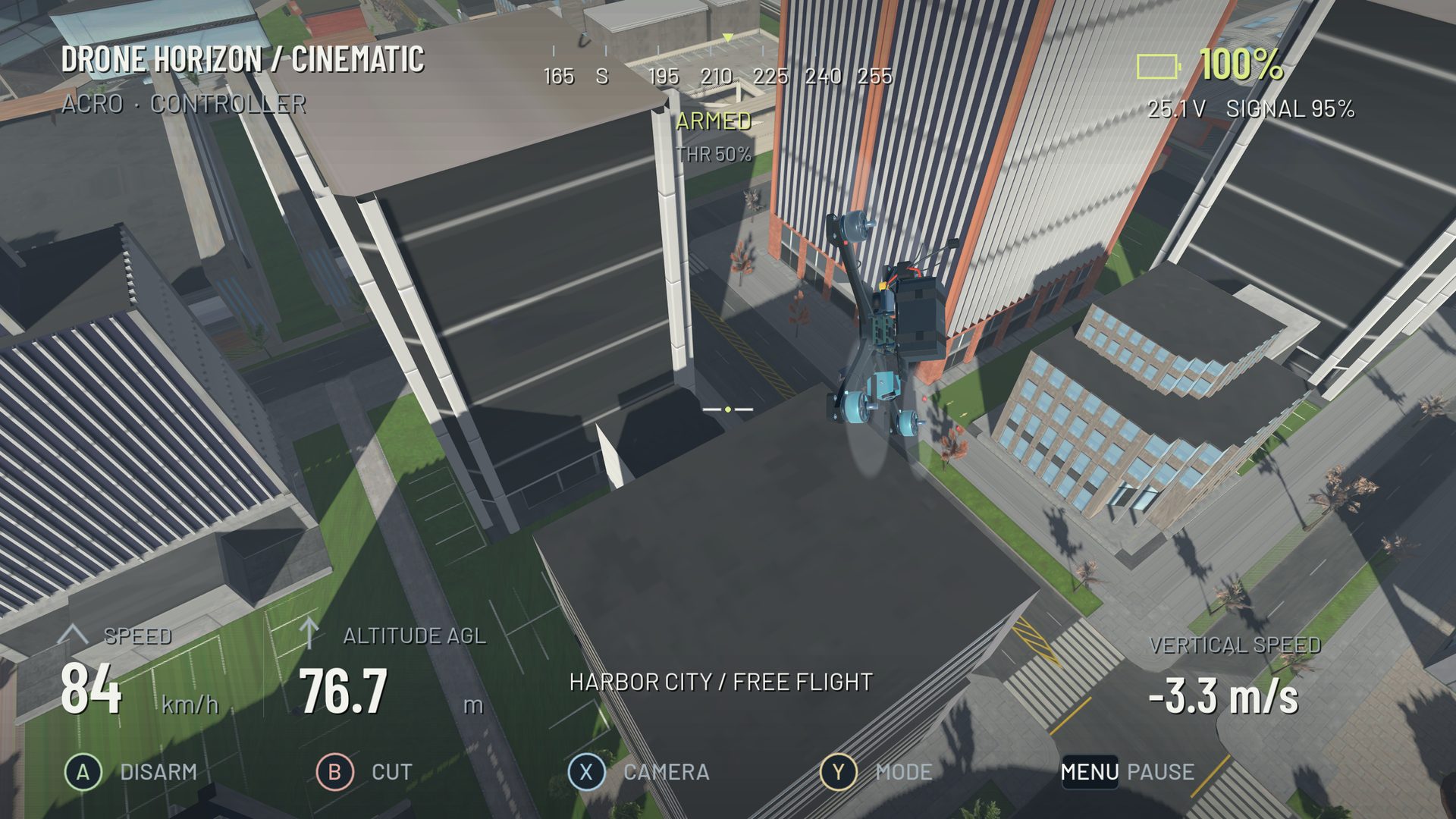
Recovering from a dive requires more than pointing the camera toward the horizon. The aircraft must reach an attitude where thrust can help change its trajectory, and it must have enough room to reduce downward motion. An upright drone can still be descending rapidly.
Use a clear simulator area and a modest descent before attempting steep building lines. This exercise is about recognizing the developing recovery, not discovering the lowest possible pullout height.
Learn the two parts of recovery
The first part is orientation: rotate the aircraft toward a useful attitude. The second is trajectory: apply and manage thrust so the motion changes in the intended direction. These interact, but they are not the same measurement.
A fixed FPV camera reports a view tied to aircraft attitude. The ground's movement and telemetry, where available, help you judge velocity. If you only watch the horizon, you may stop rotating at the right angle but underestimate how much descent remains.
Begin with a shallow descent
Establish a known height and forward line. Enter a small descending segment, then recover early into level forward movement. Repeat with the same entry speed and aircraft. Your aim is a calm exit that does not require a second abrupt correction.
Once that is predictable, make the descent steeper while retaining generous virtual space. Do not change rates, camera tilt and aircraft simultaneously. Each changes either the physical response or the cues you use to judge it.
Observe thrust direction
Motor thrust follows the aircraft's local upward direction. When the drone is inverted or strongly nose-down, a large collective command may not yet provide the world-up force you need. Applying power without understanding attitude can deepen or redirect the dive.
Conversely, waiting too long after reaching a useful attitude leaves less room to arrest descent. Learn the overlap between rotation and collective in open space instead of memorizing a single all-or-nothing throttle sequence.
| Recovery symptom | Investigate |
|---|---|
| Upright but still falling fast | Remaining downward velocity |
| Sudden backward motion after pullout | Excessive pitch correction |
| Large climb follows every recovery | Too much or too-long collective correction |
| Roll develops during pitch recovery | Unintended combined-axis input |
| Response weakens late in a session | Aircraft condition and battery settings |
Use telemetry to answer one question
Drone Horizon can display flight values and record blackbox CSV data. Compare pitch/roll attitude, vertical velocity, throttle and motor output around one recovery. Look for when the body reached a useful orientation and when the descent actually began decreasing.
This is more informative than looking only at maximum speed. It also avoids calling every difficult pullout “bad physics.” The telemetry guide describes the distinction between requested commands and actual response.
Make a clean exit the success criterion
A useful recovery ends with a manageable speed, height and heading, followed by a planned route or landing. Surviving a ground skim by chance is not the same result. Repeat the easier descent until the full exit is reliable before reducing clearance.
For related maneuvers, see Split-S practice and power loops. Simulator recovery space is a training convenience; it does not establish a safe real-world altitude or authorize proximity maneuvers around people or property.