
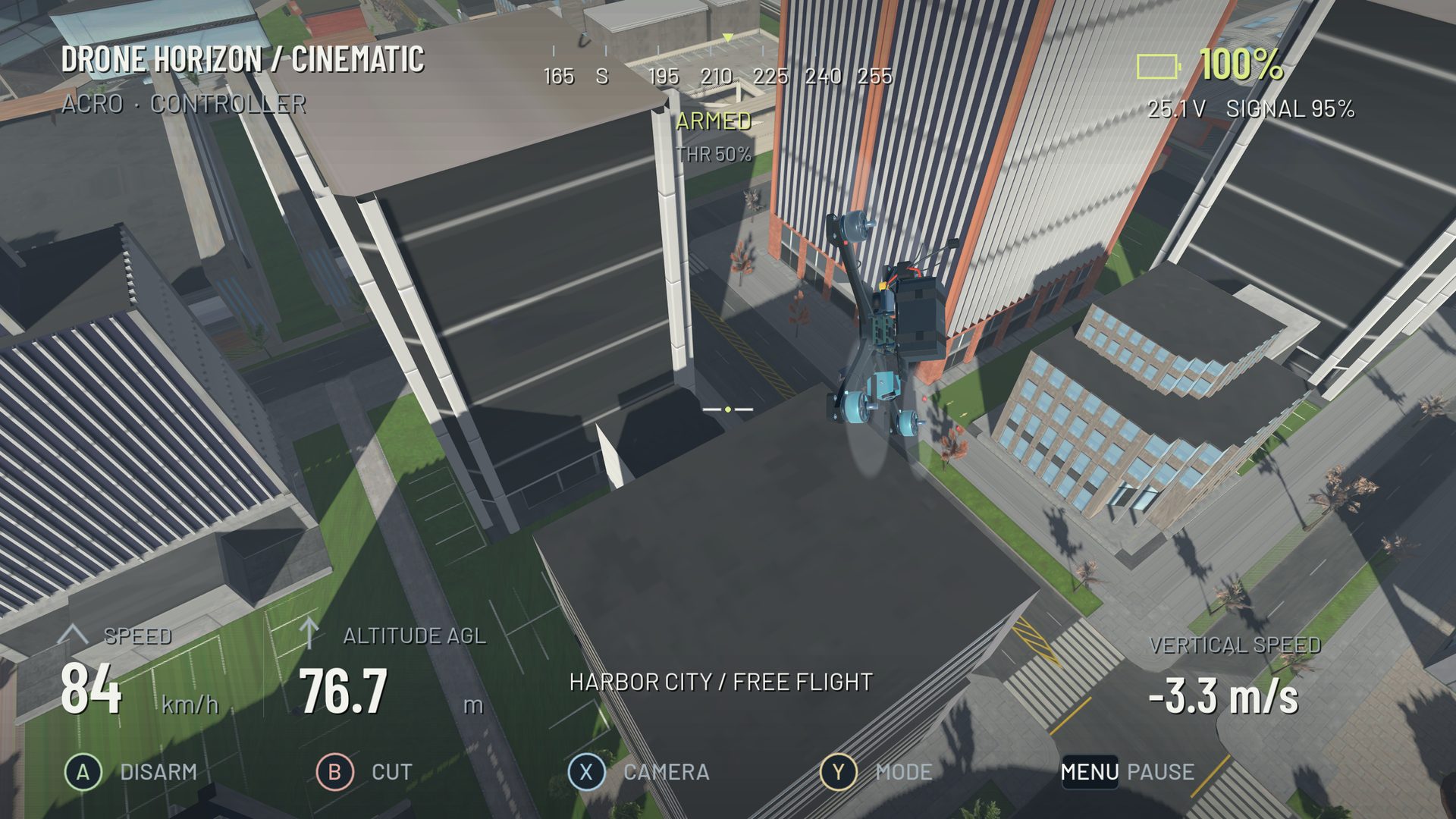
A power loop combines forward movement, a powered climb and a backward pitching arc that returns the drone toward a usable flight path. It is an Acro-style maneuver requiring deliberate control through inverted attitude. Learn the full arc in open simulator space before adding an obstacle as a reference.
This guide proposes virtual practice steps. It does not give a safe real-world clearance or a fixed throttle recipe. Aircraft thrust, rates, entry speed and the path you choose all change the required space.
Prepare the recovery first
Before attempting a full loop, practice a modest climb followed by leveling into forward flight. Then practice setting and stopping a larger pitch rotation with ample altitude. You should be able to recognize when the body is approaching a useful recovery attitude rather than relying solely on a centered-looking horizon.
Use Acro and keep the rate profile fixed. Angle's attitude limits are a different control system and should not be expected to permit the same continuous inversion.
Think in four phases
| Phase | Main task |
|---|---|
| Entry | Establish a repeatable forward line and speed |
| Climb | Build the upward portion of the trajectory |
| Rotation | Continue a controlled backward pitch through the arc |
| Recovery | Return thrust toward a useful direction and manage descent |
These phases overlap. The table is a way to observe the maneuver, not a sequence of rigid stick positions. A fixed “full throttle for this many seconds” instruction would ignore aircraft and rate differences.
Start without a gate or building
Choose a large empty region. Enter on the same line each time, climb and rotate through a broad loop, then recover into open space. If the arc is unclear, stop attempting to pass under or around scenery. The landmark should eventually help you position a maneuver you already understand.
Watch where thrust points. Inverted collective accelerates the aircraft in a different world direction from upright collective. Continuing a strong command through the wrong attitude can deepen a descent rather than rescue it. At the same time, control authority depends on the aircraft's motor system, so do not assume minimum throttle makes every phase effortless.
Diagnose the shape
If the loop stretches far behind the intended line, compare entry speed and pitch timing. If it collapses vertically, inspect the climb and when collective changes. If recovery is consistently late, reduce the task and practice the final part separately rather than making the obstacle smaller.
A loop that ends upright but moving rapidly toward the ground is not a complete recovery. You need a manageable trajectory afterward. Use dive recovery to study that distinction.
Applying the lesson in Drone Horizon
The manual FPV model uses body-rate commands and motor forces; it does not animate a canned power loop when a button is pressed. Rates, battery state and aircraft selection therefore affect how the maneuver develops. Keep them constant during the first practice block.
Once the open-air loop is repeatable, use a generous virtual reference with a clear abort direction. Do not treat a successful simulated loop as permission to reproduce it around real obstacles. Continue with the freestyle progression and compare a Split-S as a different entry and recovery problem.