
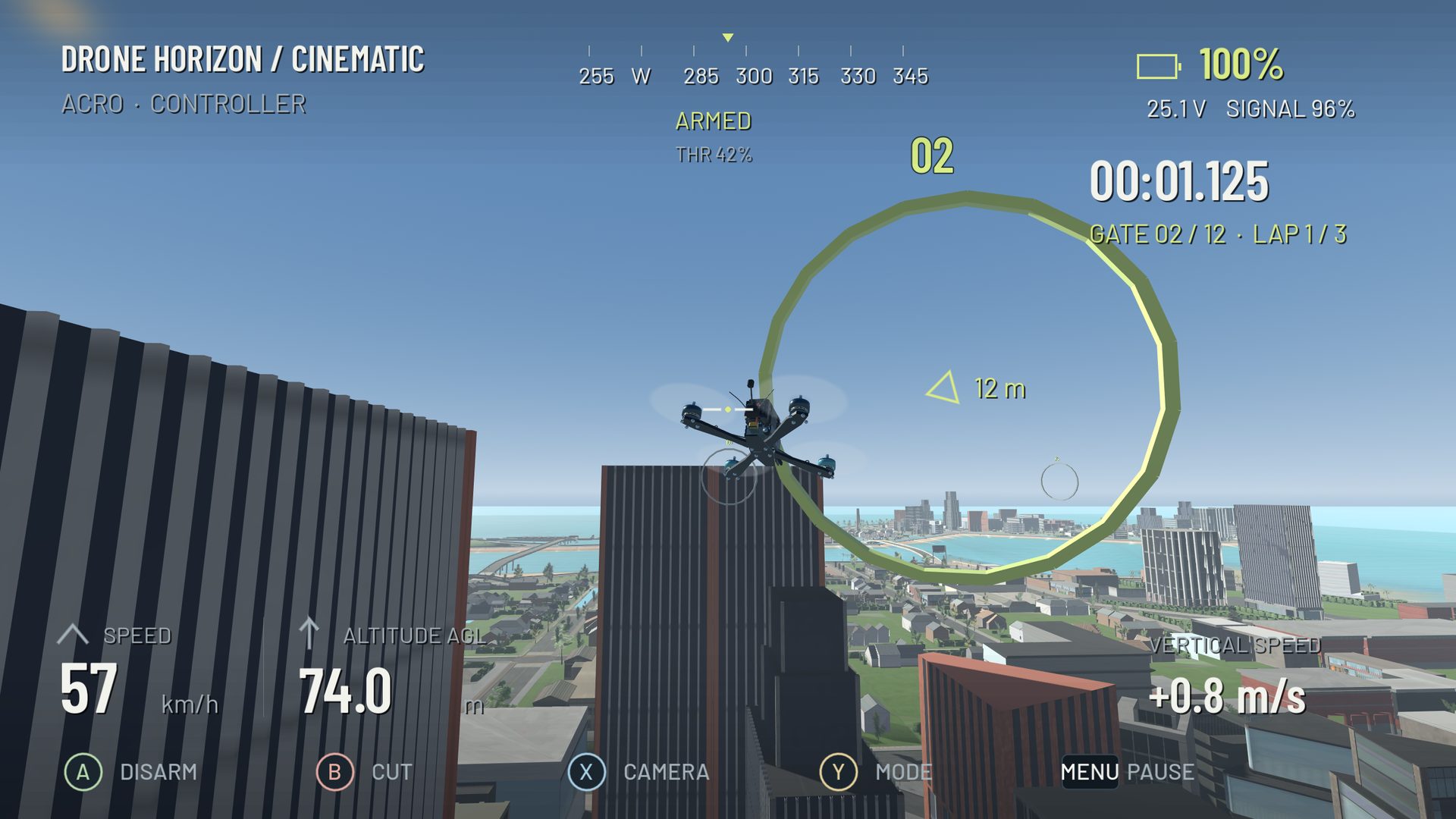
A racing line is the path that connects the whole course. The shortest-looking path through one corner is not necessarily the easiest or quickest path through the next two gates. A useful line balances distance, speed, control effort and the position it leaves you in afterward.
Begin by learning the route at a speed where you can look ahead. If every opening arrives as a surprise, a more aggressive setup will mostly make the surprises happen faster.
Read a pair of gates as one problem
Pick two consecutive gates. Describe the desired exit from the first: heading, bank, height and travel direction. Then ask whether that exit naturally leads toward the second. If it requires an immediate reversal or a large climb, the first pass may be sacrificing the next approach.
This is why aiming for the visible center of every gate can still produce a poor route. The aircraft has momentum and a physical width. A line must fit both the opening and the transition that follows it.
Compare two deliberate options
Fly a wider, calmer line first. Save or note the result using the simulator's available timing, or simply count clean repetitions. Then test a tighter option at a similar entry speed. Compare the entire two-gate sequence rather than the instant you pass the first frame.
| Compare | Useful question |
|---|---|
| Entry | Can you reproduce the starting speed and position? |
| Turn | Is bank set deliberately or continuously increasing? |
| Exit | Does the next gate become easier to approach? |
| Reliability | How often is the complete sequence clean? |
| Penalties | Did a shorter path add contacts or resets? |
A tight route that works once but fails most attempts may be worth learning later. It is not automatically the best training baseline.
Make braking part of the line
In manual FPV, pointing elsewhere does not erase velocity. You may need to change attitude and thrust early enough to reduce or redirect movement before the next gate. If the aircraft repeatedly overshoots, examine where braking begins rather than only how hard you pull at the end.
The overshooting guide separates late entry, excess speed and control-response problems. Keep the flight mode in mind: stabilized braking changes the task compared with manual Acro.
Apply the rules of the actual course
Drone Horizon has ordered gates, timing, personal records and configurable gate-hit penalties. Its Neon City tracks are authored courses rather than copies of the generic three-lap format. Compare times with the same course and equipment settings; a run with different penalties or gate difficulty answers a different question.
A respawn is also a recovery tool, not a line shortcut. Use it to repeat a difficult segment and understand the intended crossing direction.
Progress from pairs to a lap
Once a pair is repeatable, add the next gate and repeat the process. Eventually the route becomes a set of familiar transitions instead of isolated obstacles. Look ahead far enough to prepare, while still using the current opening as a position reference.
Finish by flying a complete lap at a deliberately manageable pace. Identify one transition that costs the most control effort, and make that the next practice target. The racing practice guide explains how to turn those observations into a session without chasing an unexplained personal-best number.