
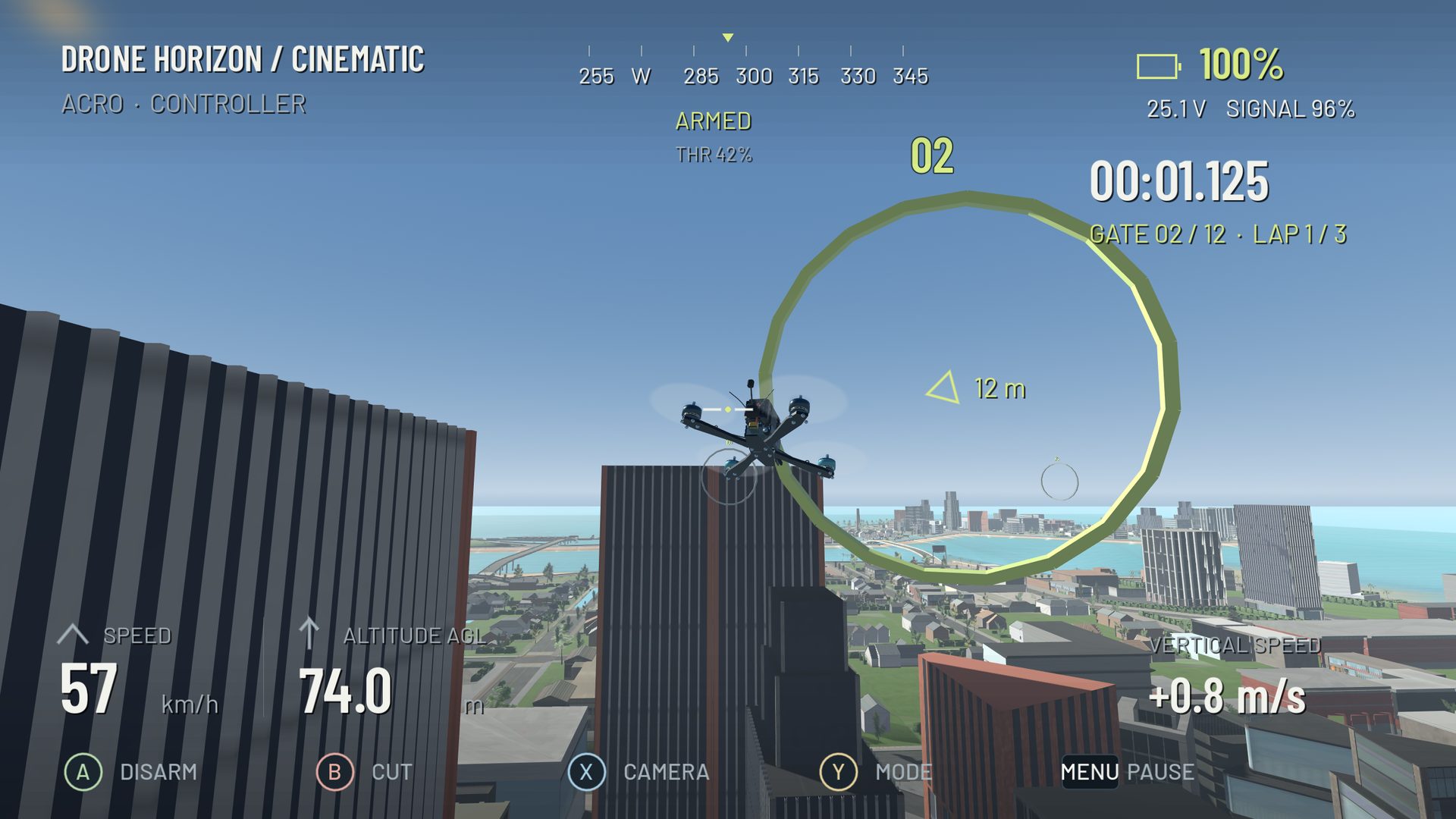
A clean gate pass starts before the aircraft reaches the frame. You need an approach that intersects the opening, enough space to correct early and an exit that sets up the next part of the route. Centering the gate in the camera is helpful, but it does not prove the drone's current trajectory passes through it.
Begin with a generous opening and a straight approach in the simulator. Tight gates and high speed can wait until the basic crossing is repeatable.
Build a straight reference pass
Choose a starting landmark far enough away to stabilize the aircraft before the gate. Approach with a modest, repeatable speed. Make the main heading and lateral corrections while the opening is still ahead, then avoid a large last-second input at the frame.
Continue straight beyond the gate before turning around. This makes the exit visible as part of the task. If you celebrate the instant the gate clears and stop controlling the path, you have practiced only half the maneuver.
Diagnose the miss by where it starts
| Miss pattern | Inspect |
|---|---|
| Camera points through, aircraft slides past | Existing lateral momentum and approach bank |
| Height drops at the opening | Throttle coordination during alignment |
| Frame hit follows a sudden correction | Late input or excessive approach speed |
| Crossing does not count | Direction, order and the active checkpoint |
| First gate passes, second becomes impossible | First exit line rather than only second entry |
Use the same entry on the next attempt. If every miss begins from a different speed and angle, comparing corrections becomes guesswork.
Add a second gate
Choose a pair with a manageable turn between them. Look through the first opening toward the route to the second. A perfect geometric center on gate one may be less useful than a legal crossing that leaves a calmer second approach.
Keep the first few attempts slow. Identify where to establish bank, where to remove it and when to adjust throttle. Only then increase speed slightly. If a faster pass demands a violent correction inside the second opening, the line has become less repeatable even if one attempt succeeds.
Understand the simulator's checkpoint rules
Drone Horizon checks ordered, directional crossings using the segment between the drone's previous and current positions. This helps detect fast passes that might skip a simple overlap event. Its physical gate frames can still be contacted, and optional gate-hit penalties affect timed runs.
Flying backward through a gate or crossing a later checkpoint first is not necessarily a valid pass. Neon City has authored course-specific gates, so do not assume every environment uses the same number or generic lap format. See the racing feature guide.
Increase one difficulty at a time
Once a gate pair is repeatable, increase speed, reduce opening size or add a more demanding turn—choose one. Keep the others stable so you can identify what caused a new miss. Wider practice gates are useful training equipment, not an admission of failure.
End the drill with several controlled passes at the easier setting. Count clean sequences and describe the most common miss. For further progression, use racing lines and slalom practice to connect gate control into a longer route.