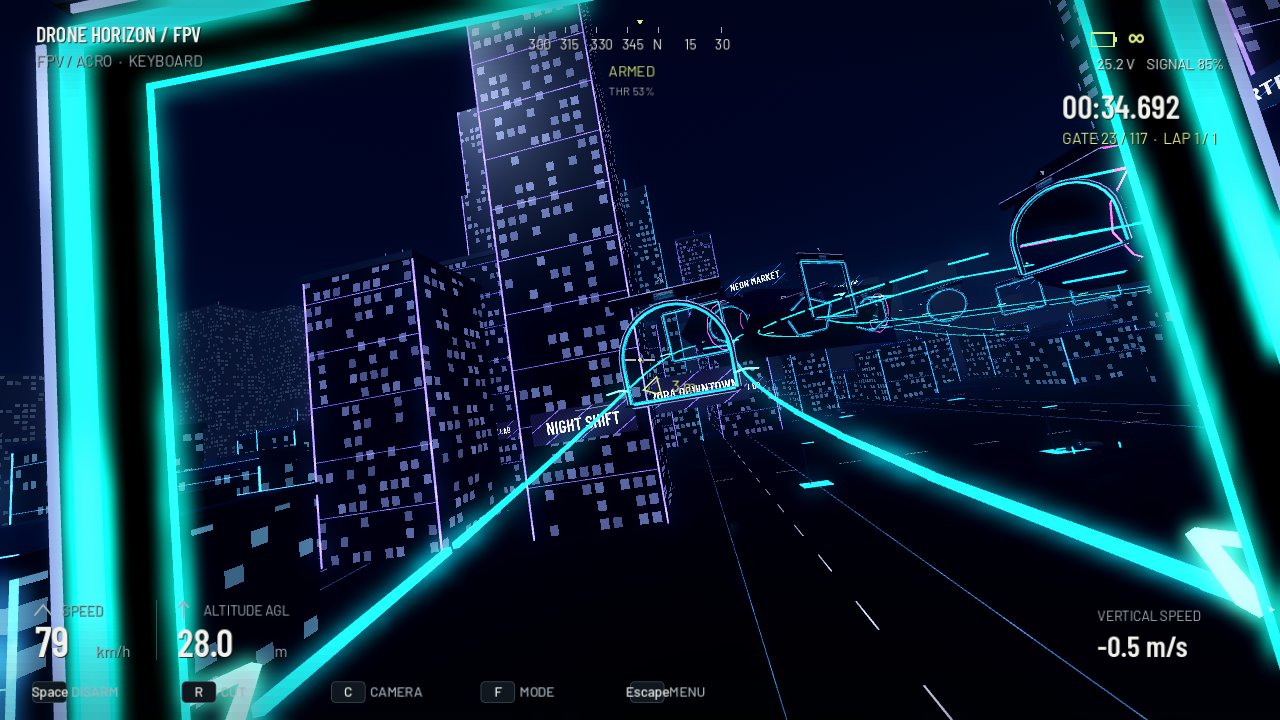
A faster FPV lap usually begins with a cleaner previous turn. If you enter a gate too fast or too wide, the next gate becomes a late correction. A simulator is useful because it lets you fly the same sequence until you can see where the line breaks down.
This guide assumes you can hold a basic FPV line and recognize the four control axes. If you are still learning camera orientation, begin with the FPV beginner guide. Keep the same aircraft, camera tilt and rates throughout a practice block.
First, learn the route without timing it
Fly the course slowly enough to read every gate before you reach it. Say the next gate's position to yourself before you pass the current one. This forces your attention beyond the opening immediately in front of the camera.
Make one or two laps at a controlled speed. Do not use the clock as a target yet. Identify the turns that need an early setup and the gates that can be linked with one smooth arc. A gate is not the whole problem; the exit direction determines whether the next section is easy.
Practice one gate pair
Choose two consecutive gates. Approach the first gate at the same height and speed on every repetition. Fly through, set your bank and yaw toward the second gate, then watch whether you arrive centered or need a last-second correction.
If you repeatedly miss the second gate to the outside, start the turn earlier or enter the first gate more slowly. If you clip the inside, delay the turn or widen the entry. Change one variable at a time. Constantly changing rates or camera angle hides the cause.
Add speed only when the line repeats
A useful sequence is:
- Make three clean passes through the gate pair at a comfortable pace.
- Increase entry speed a little while keeping the same turn point.
- If the line falls apart, return to the previous speed and adjust the setup.
- Link another gate pair, then fly a complete lap.
The clock becomes useful once you can finish laps. A faster split with a wider exit may be worse if it costs time in the next section. Compare complete sequences, not isolated gate crossings.
What to watch in the FPV view
Keep the next gate in view as early as possible. Use the ground and skyline to judge bank and height. When a turn tightens, do not assume yaw alone will bend the flight path; roll sets lateral thrust, while pitch and throttle affect speed and height. Our control guide explains why these axes interact.
In Acro, remember to remove a bank deliberately. Centering the roll stick stops the requested roll rate; it does not level the drone. Acro versus Angle covers this difference.
A 20-minute simulator session
Spend five minutes on route memory, ten minutes on one difficult gate sequence, and five minutes on full laps. Write down one observation after each block: late turn into gate four, too much height at the exit, or clean line at lower speed. That note gives the next session a purpose.
Drone Horizon's Harbor City racing mode times three-lap runs through ordered gates; Neon City has its own night courses. Missed entries become obvious in either environment. Use the racing learning path to work from basic control toward consistent runs. Simulator practice can prepare stick timing and route reading, but real racing adds hardware setup, safety procedures and site conditions that a screen cannot reproduce.