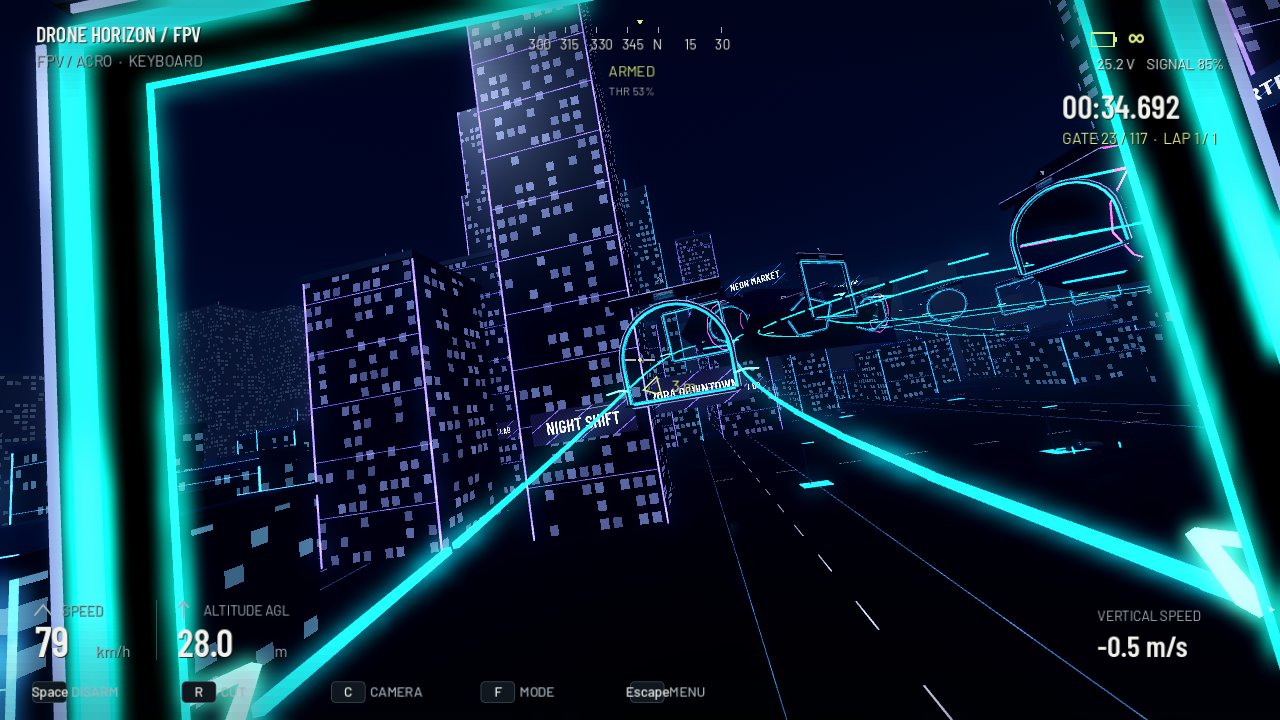
Neon City is Drone Horizon's authored night-racing environment. The current project data contains fourteen districts and six selectable courses, ranging from Rookie Circuit to a longer Championship Circuit. It is a distinct course environment, not simply a blue filter applied to Harbor City.
The course selector and gate system are present in the active map flow. This guide describes those verified systems and suggests how to practice with them; it does not claim a fresh runtime acceptance test of every exported build.
The six course choices
| Course | Useful practice question |
|---|---|
| Rookie Circuit | Can you follow ordered gates with a controlled exit? |
| Neon Downtown | Can you read the next route through the urban setting? |
| Industrial Rush | Can you maintain a repeatable line through the industrial course? |
| Tunnel Attack | Can you prepare the approach before entering a constrained passage? |
| Rooftop Nightmare | Can you manage altitude and transitions above the city? |
| Championship Circuit | Can you preserve consistency across a longer sequence? |
The questions are suggested practice goals. The course names and six authored selections come from the game. “Championship” is the fictional event presentation, not an affiliation with a real racing federation or a promise of multiplayer competition.
Select the course before planning the session
The Neon City preflight menu displays course information and lets you select among the authored routes. Gate arrays and starting positions are course-specific. Do not assume that every route uses the generic Drone Racing mode's three-lap structure; the Neon path is handled as an authored course run.
The menu also compares your altitude limit with the selected route and can offer the course's recommended setting. If a route rises above your current limit, resolve that before launching rather than interpreting the boundary response as a failed pitch command.
Learn the route at a readable pace
Begin with a reconnaissance pass. Identify where an exit sets up the next gate, where altitude changes and where you need to reduce entry speed. Ignore the temptation to chase a best time before you know the direction of every opening.
Then choose one difficult pair and repeat it. A wider first line may make the second gate easier. Use the racing-line method to compare the whole transition rather than only a fast first crossing.
What counts as a pass
Drone Horizon checks ordered directional crossings through the active gate. The frame is physical geometry, and contact handling is distinct from passing through the valid opening. Timing and penalties therefore need to be read together.
If a checkpoint does not advance, check the active gate and crossing direction. If you contact a frame, inspect the approach trajectory rather than relying solely on the camera being centered. The gate training guide covers those diagnostic steps.
Presentation without automated piloting
Neon City's event system includes lighting, an event display and finish presentation. The race director does not steer the aircraft through a live run. The pilot remains responsible for flight; the completed result presentation is a separate phase.
For consistent comparisons, keep the aircraft, rates, camera, course and penalty settings unchanged. Switching all of them after a difficult lap makes progress impossible to interpret.
A useful progression
Start with the route you can read most comfortably. Build several clean segments, connect them into a run and only then add speed. Move to a more demanding course when the current one leaves attention available for planning rather than constant recovery.
For a contrasting environment, the maps guide covers Harbor City, forests, indoor spaces and mountain routes. For an activity without ordered race gates, Follow Car develops moving-subject framing while leaving the drone under your control.