
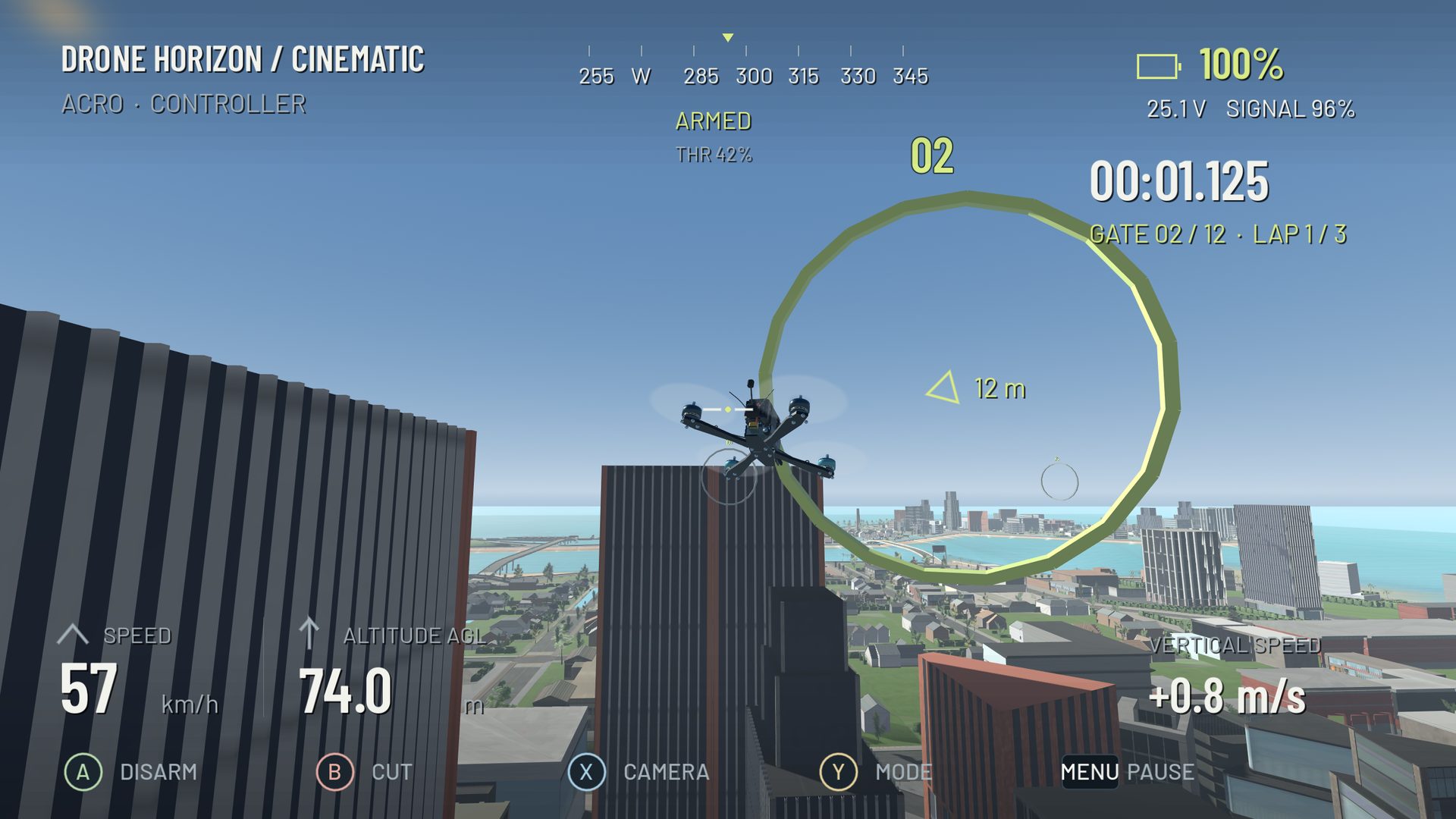
Race a connected route
Drone Horizon includes Time Trial, Drone Racing and Precision session rules alongside Free Flight and Landing Challenge. Map capabilities control which options are appropriate. The general Drone Racing session uses a multi-lap format, while Neon City's authored courses follow their own single-course run structure.
This matters when comparing results: the selected map, course and equipment settings define the task. A faster number from a different configuration is not necessarily an improvement on the same route.
Gates have direction, order and geometry
The checkpoint system evaluates movement across a gate plane between consecutive positions. It tests the opening and crossing direction rather than relying solely on whether the aircraft overlaps a trigger for one rendered frame.
Physical frames and crossing logic serve different purposes. You can contact a frame without making a valid ordered pass, and a backward crossing need not advance the course. The active gate is the next required target.
Timing includes the selected rules
The race manager tracks progression and timing. Crash, reset and optional gate-contact penalties can affect the result. The pilot profile stores records and game progression. These are local game systems, not evidence of a public online leaderboard or multiplayer championship.
Use the same course and penalty settings for a meaningful comparison. If a shorter line adds frequent contacts, examine its overall repeatability rather than only the best-looking attempt.
Neon City is an authored course family
The night environment contains six routes: Rookie Circuit, Neon Downtown, Industrial Rush, Tunnel Attack, Rooftop Nightmare and Championship Circuit. Preflight shows course information and checks your altitude limit against the route's needs.
Course presentation includes event lighting and a finish sequence. It does not steer the aircraft during a live run. See the Neon City guide for the practical distinctions.
Practice before chasing the clock
Fly a route slowly enough to read its order. Isolate a difficult pair of gates and plan the first exit as the second entry. Add speed only after that connection becomes reliable. This is more useful than alternating full-throttle attempts with unrelated settings changes.
The racing hub links gate training, slalom and line analysis. These are proposed practice methods built around the verified game systems, not claims of professional training accreditation or guaranteed lap-time gains.