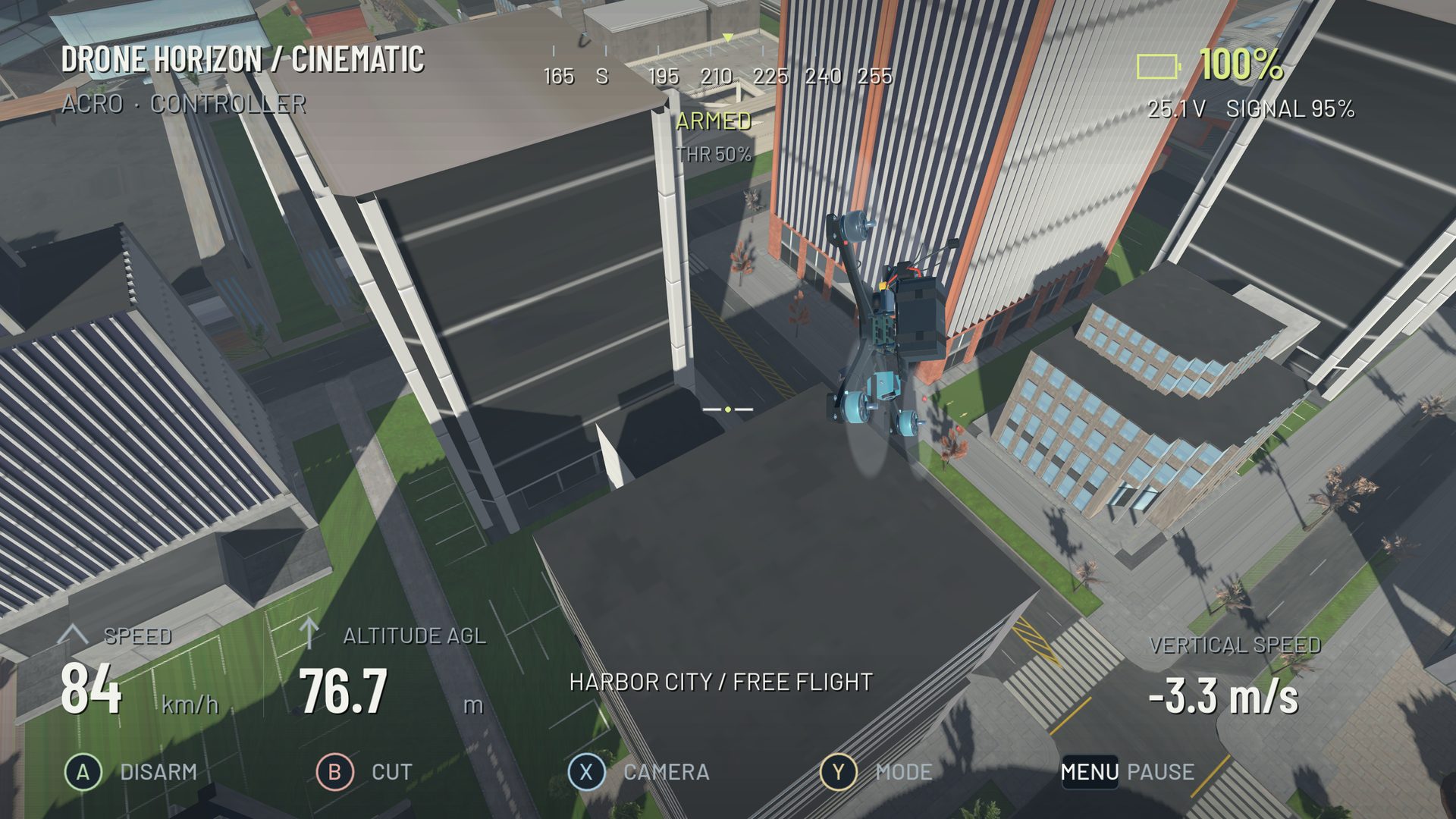
Freestyle is controlled movement through space: a roll, flip or dive has an entry, a rotation, a recovery and an exit line. The trick itself is only one part of it. A simulator helps because you can repeat the entire sequence without risking a real frame or props every time you miss the recovery.
Start in open air. Buildings and gaps can wait until you can tell where the aircraft will be after the maneuver. Acro mode is the usual foundation because the pilot, not a self-leveling controller, sets and removes the aircraft's attitude.
Learn the entry before the trick
Pick a consistent start point and heading. Fly a straight line at a modest speed, then return and repeat. Keep the same camera tilt and aircraft. If the entry changes every time, you will not know whether a later recovery problem came from the maneuver or the setup.
For a first roll, choose generous height and open space. Make a brief roll input, then stop rotation at the intended attitude. Watch what happened to your height. Repeat with smaller or more deliberate input. The goal is a predictable rotation and a level exit, not the fastest spin.
Manage altitude deliberately
Tilting the drone redirects thrust. During a steep bank or inversion, the motors are not providing the same upward component they provide in level flight. A late throttle increase cannot always recover lost height instantly because the aircraft must also return to a useful attitude. In Drone Horizon, the motor forces act along the drone's local thrust axis, so inverted thrust points downward rather than magically holding altitude.
Practice a simple cycle: level flight, small bank, level flight, check height. Then extend the bank angle. If you consistently lose height, change the timing and shape of the maneuver before simply adding more throttle everywhere.
Build a recovery habit
After each attempt, ask three questions:
- Was the aircraft level when the rotation stopped?
- Was there enough altitude left to fly out of the maneuver?
- Was the nose pointed toward a clear exit?
If any answer is no, slow down or move the start point higher. A simulator reset is instant; use it to isolate the error. Do not turn every crash into a different trick.
Move from open air to the city
Once a roll or flip has a repeatable entry and exit, place it near a large visual reference such as a rooftop edge. Leave room on every side. Gradually reduce the margin only when you can predict where the aircraft will be at the end. For a power loop or dive, learn the broad arc first; proximity makes the same control mistake much more costly.
Drone Horizon's freestyle flight lets you practice Acro around Harbor City with collisions. Follow the freestyle learning path and revisit the FPV camera basics if you lose the horizon during recovery.
A simulator can improve control timing and spatial judgment. It cannot make a real location safe. When moving to a physical quad, evaluate the site, the aircraft and the people nearby before attempting any maneuver.