
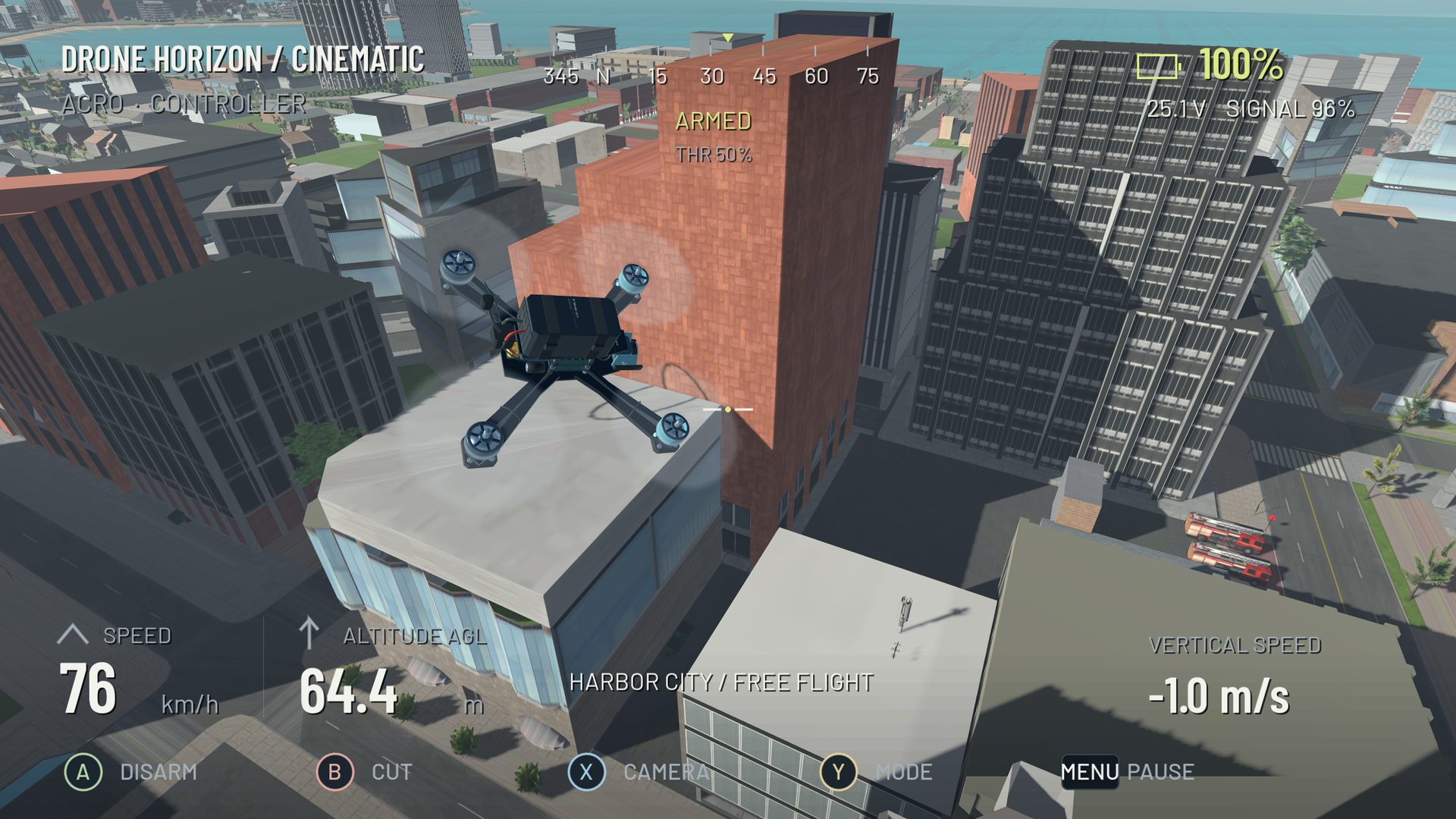
Centering the sticks does not necessarily stop a drone. In manual FPV, the aircraft can retain both its attitude and its velocity. Wind adds another distinction: the drone moves through air that may itself be moving relative to the ground.
To understand an unexpected drift, separate the command, the body's orientation, ground-relative movement and air-relative movement. They answer different questions.
Momentum continues after an input ends
An Acro pitch command changes rotation. When you center the axis, the target rotation can return toward zero while the aircraft remains tilted forward. The tilted thrust can keep accelerating it. Even after leveling, existing forward motion must be changed by forces; it does not vanish because the stick stopped moving.
Angle helps return attitude toward level, but leveling alone is not automatic position hold. A stabilized camera-drone controller can add braking and hold behavior, making centered sticks mean something different at the movement-control level.
Wind acts through relative airflow
Aerodynamic effects depend on how the aircraft moves relative to the surrounding air. A drone stationary over the ground in moving air can experience drag. A drone traveling with the air has a different relative flow than one moving against it at the same ground speed.
Drone Horizon's aerodynamics code uses local air-relative velocity for drag and includes configurable wind speed, direction and gust settings. This provides a way to explore disturbances. It does not imply a weather forecast, a perfect turbulence model or measured reproduction of a particular site.
Run a controlled wind comparison
Start with wind off and establish a baseline straight route and return. Then enable a modest wind setting while keeping aircraft, view and rates unchanged. Repeat in both directions. Observe how much correction is needed and whether the two legs differ.
If you begin by changing several aerodynamic settings at once, the result becomes difficult to interpret. Save the baseline so you can return to it after the comparison.
| Observation | Question to ask |
|---|---|
| Drone drifts with centered Acro sticks | Is the body still tilted or already moving? |
| One direction feels harder | What is the configured wind direction? |
| Centered sticks produce active braking | Which flight family is selected? |
| Height changes in a bank | How much thrust remains directed upward? |
| Motion differs late in the session | Did battery state or damage change? |
Compare assisted and manual flight honestly
Drone Horizon's DJI-style stabilized controller includes braking, position hold and altitude management. The Standard manual and FPV/Acro families teach a different task. A stable hover in the assisted family does not demonstrate that the pilot manually balanced collective against a disturbance.
Both can be useful. Use manual flight to study attitude and thrust coordination; use stabilized flight to study camera-drone movement and framing. The flight-family guide explains the distinction without implying DJI hardware compatibility.
Keep the model's limits visible
Optional ground-effect and wake behavior are bounded simulator approximations. They should not be described as computational fluid dynamics or as proof that a particular real drone will recover from the same disturbance.
Use the physics overview for the force model and overshooting diagnosis when momentum creates a recurring corner problem. The most useful lesson is to plan the force needed to change a trajectory early, rather than expecting centered sticks to erase it.