
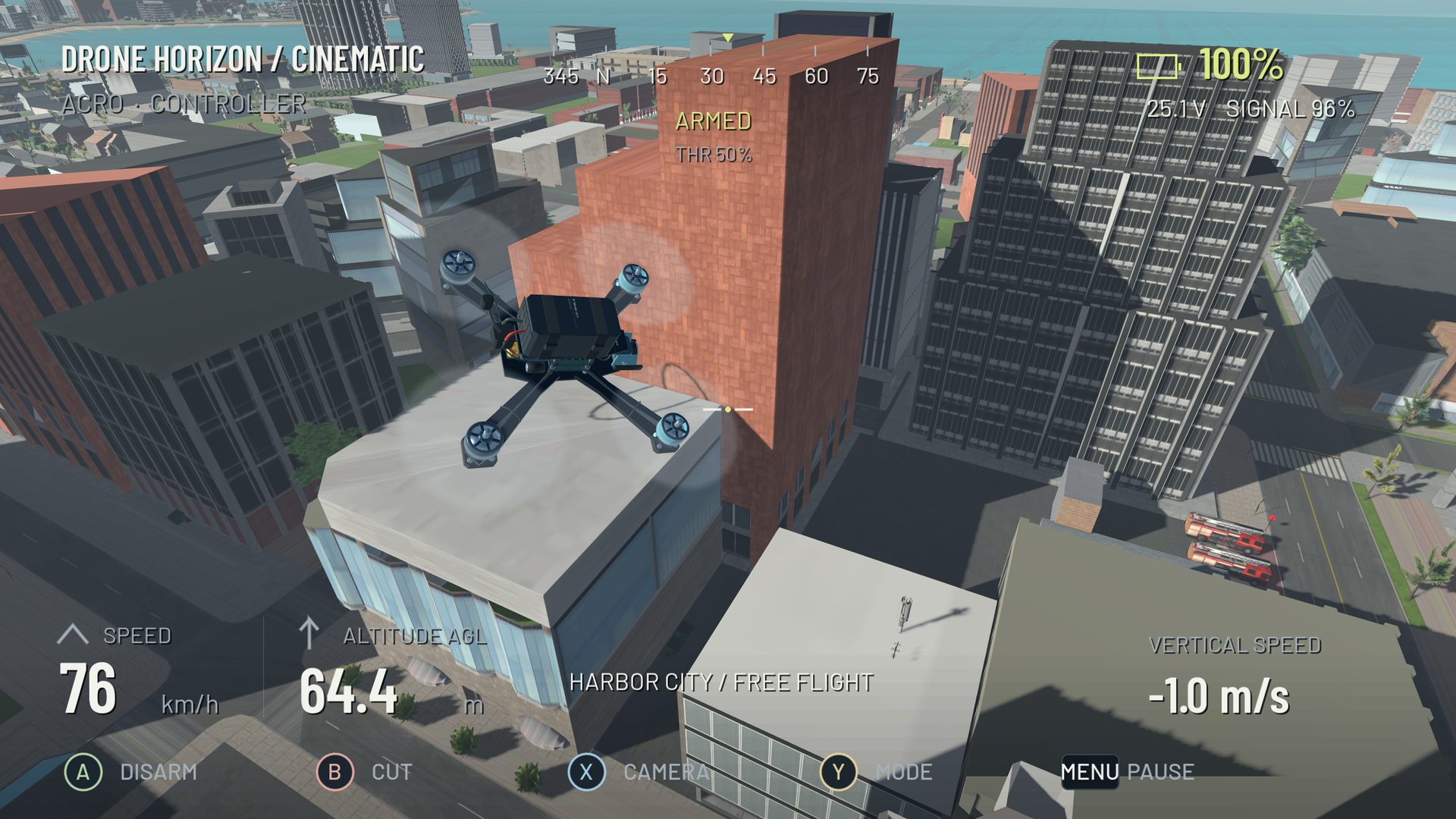
A quadcopter moves because its propellers produce forces. Together those forces can support weight and accelerate the aircraft; differences between motors also create turning effects. The aircraft's mass and inertia determine how it responds to the resulting forces and torques.
This explanation describes a useful physical model, not a claim that every simulator reproduces every aerodynamic detail. Drone Horizon's fictional aircraft specifications are simulator parameters, not measurements of named commercial drones.
Thrust must be considered in a direction
With the aircraft upright, motor thrust points roughly upward. Tilt the body and the same thrust vector gains a horizontal component. That is why pitch and roll affect the flight path as well as the view.
For a simplified steady, level hover, total upward thrust balances weight. During a bank, only part of total thrust points upward. Maintaining height can require more total thrust, subject to the aircraft's available motor output. NASA's thrust-to-weight explanation provides background on why thrust must be compared with the weight it acts against.
Mass and inertia answer different questions
Mass affects how strongly a given net force accelerates the aircraft. Rotational inertia affects how strongly torque changes rotation. Two drones with the same mass can have different rotational behavior if that mass is distributed differently.
A motor's distance from the center of mass also matters: its force acts through a lever arm. A simulator that represents individual motor locations can use those offsets in the pitch/roll torque calculation instead of assigning an arbitrary turn animation.
| Quantity | Describes | Example consequence |
|---|---|---|
| Force | A push in a direction | Changes velocity |
| Torque | A turning effect | Changes angular motion |
| Mass | Resistance to linear acceleration | Same force yields different acceleration |
| Inertia | Resistance to angular acceleration | Same torque yields different rotation response |
| Drag | Aerodynamic resistance relative to air | Movement decays without an instant stop |
How stick commands reach the motors
In Acro, the pilot requests rotation rates. A control loop compares requested and measured motion and asks the motor mixer for the required torque. The mixer must respect the limits of four motors while also providing collective thrust.
Angle and Horizon add attitude-related behavior before the rate-control stage. Drone Horizon's separate stabilized family adds movement and hold control, but still sends commands through the motor-driven aircraft model. It does not make the entire game manual-only or replace the body with a visual path animation.
What Drone Horizon implements
The source includes rigid-body flight, individual motor forces at motor positions, reaction torque, spool response, explicit inertia, drag, battery-dependent power and impact damage. It offers 120, 250 and 500 Hz physics precision choices. Those frequencies describe simulation updates, not guaranteed frame rates or a measured fidelity ranking.
The model also contains bounded aerodynamic approximations. Calling these “realistic physics” should mean specific mechanisms are present, not that the simulator is a validated engineering predictor for an actual airframe.
An experiment you can repeat
Keep controls, camera and conditions fixed. Fly the same small acceleration-and-stop exercise with two simulated aircraft. Notice how the heavier or differently configured model develops and sheds movement. Then repeat a shallow bank and recovery.
Use telemetry to compare commands with response if the visual result is unclear. For related effects, read wind and momentum and collision physics. The goal is understanding why the aircraft behaves as it does, not choosing the highest number in every settings menu.